The Village of Aldbury, Hertfordshire — History & Facts
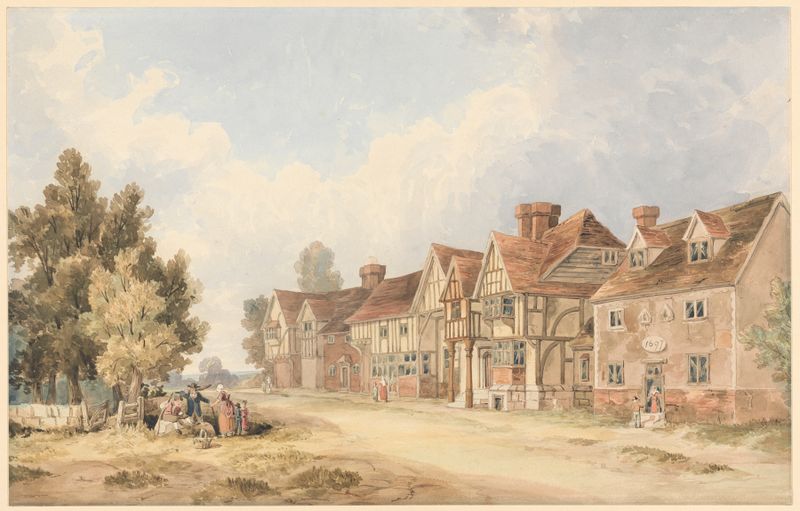
Could beauty survive in a century of chaos? In George Shepheard's The Village of Aldbury, Hertfordshire, we find a serene testament to the endurance of tranquility amidst the tumult of the early 19th century. The painting invites us to reflect on the delicate balance between human existence and the relentless march of time, revealing a moment captured in hushed grace. Look to the center of the canvas, where the village emerges, framed by gently rolling hills under an expansive sky. Notice how the soft light bathes the quaint cottages, illuminating their warm hues while casting shadows that hint at the lives once bustling within.
The artist's careful brushwork captures the texture of the landscape, inviting your eye to explore the subtle interplay between the earth and the sky, where the clouds whisper secrets of the day. Delve deeper, and you'll uncover the poignant contrasts woven through the scene. The stillness of the village juxtaposes the tumult of the surrounding world, suggesting a longing for peace amidst chaos. The emptiness of the streets evokes a sense of absence, perhaps reflecting the ghosts of those who once filled the air with laughter and life.
Each detail—from the silent windows to the distant treetops—serves as a reminder of transience, offering both solace and sorrow. Shepheard painted this work in 1816, a time when Europe was grappling with the aftermath of the Napoleonic Wars, and social upheaval was pervasive. Living in England, the artist captured a moment of stillness in a world rife with uncertainty. This painting stands not only as a representation of a village but as a silent witness to a period yearning for stability and beauty amid the chaos surrounding it.