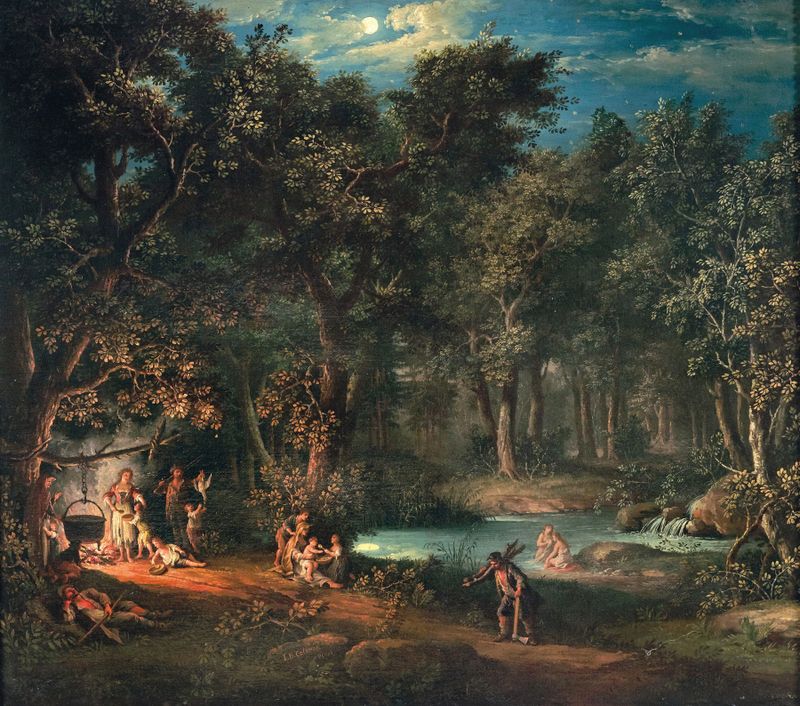
Travellers in a nocturnal landscape with lightning — History & Facts
In an unlit world, the shadows weave a narrative rich with longing and loss, inviting us to uncover our own sorrows beneath the surface. Begin your exploration at the stormy horizon where ominous clouds swirl in shades of deep indigo and gray. Notice how striking flashes of lightning illuminate the landscape, casting a fleeting glow that reveals the silhouette of weary travelers. Their dark forms stand in stark contrast to the tempestuous sky, emblematic of humanity's struggle against the elements.
The artist masterfully employs chiaroscuro, allowing light to carve out details in the darkness, while the tumultuous colors evoke an emotional resonance that straddles the line between despair and hope. As you delve deeper into the painting, observe the subtle expressions of the travelers—each face a canvas for unspoken grief. The jagged light not only reveals their physical journey but also suggests an emotional pilgrimage through pain and uncertainty. The landscape itself, though beautiful, is fraught with peril; it represents both the external forces of nature and the internal battles we face.
The tension between the powerful storm and the fragile figures invites viewers to reflect on their own vulnerabilities and the transient nature of existence. Giovanni Battista Innocenzo Colombo painted this work during a time when Europe was steeped in change and turmoil. The exact date remains unknown, but his career flourished in the late 17th century, a period marked by dramatic shifts in artistic expression. Amidst the rigid constraints of Baroque conventions, the artist sought to explore more emotive landscapes, establishing a bridge between the natural world and the emotional landscape of humanity.