Uferlandschaft am Starnberger See mit weidenden Kühen — History & Facts
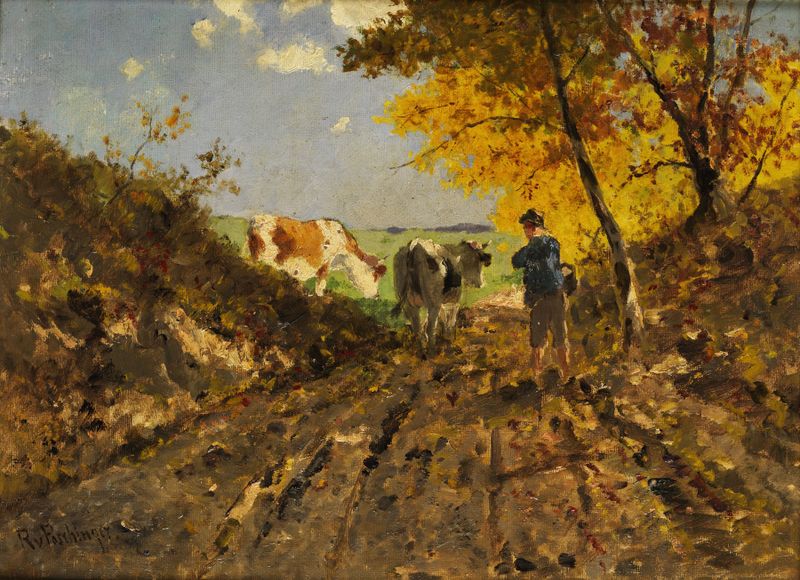
Could beauty survive in a century of chaos? In Uferlandschaft am Starnberger See mit weidenden Kühen, the balance of nature unfolds effortlessly, inviting the viewer to linger in its serene embrace. Look to the left at the gentle curve of the lake's edge, where soft ripples mirror the delicate clouds above. The palette, awash in greens and blues, suggests a harmonious relationship between earth and sky, while the grazing cows dot the landscape, grounding the scene in pastoral tranquility. Notice how the light filters through the trees, casting dappled shadows that dance along the grassy banks, establishing a sense of depth and warmth that draws you in. At first glance, the idyllic backdrop seems solely a celebration of peace, but beneath lies a tension between nature's stillness and the encroaching industrial world of the late 19th century.
The cows symbolize a vanishing way of life, representing both sustenance and simplicity in contrast to a rapidly changing society. Here, the duality of beauty and impermanence resonates, inviting contemplation of what will endure as the modern age unfolds. Richard Von Poschinger painted this work in 1880, during a time when Europe was increasingly grappling with industrialization and urbanization. Residing in Bavaria, he sought to capture the landscapes that were emblematic of his homeland, ensuring that the pastoral scenes would be documented amidst the transformations of society.
His work reflects a yearning for continuity in the face of change, a theme that remains relevant today.