View into the Heyday of Greece — History & Facts
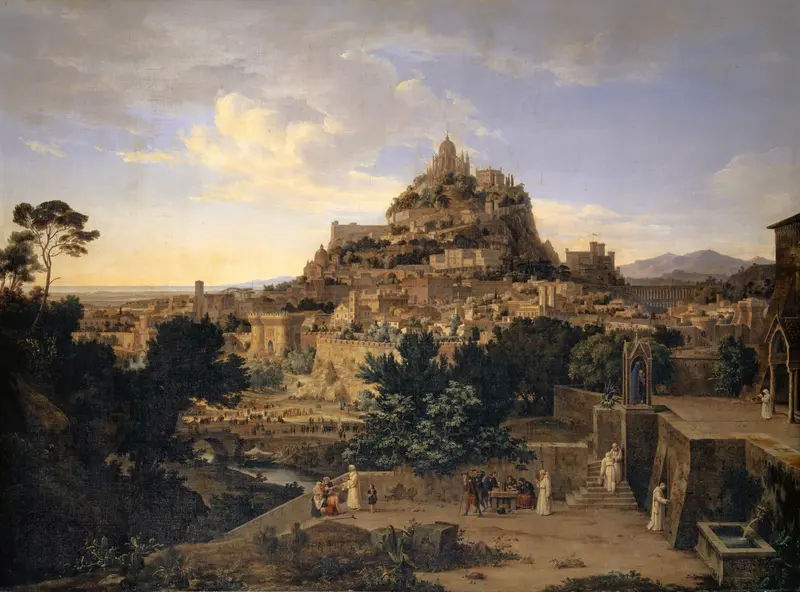
The first thing that seizes the eye in View into the Heyday of Greece is the sheer ambition of its vision: a city in the throes of creation, where every figure is caught mid-action, and the landscape stretches out in luminous detail to a distant, sunlit Acropolis. The foreground is alive with the sweat and muscle of builders raising a monumental temple, their bodies taut with effort as they maneuver marble blocks and sculpted friezes into place. The light pours in from the left, gilding the columns and the workers’ skin, while the city beyond unfolds in orderly splendor—temples, statues, and avenues all radiating from the sacred hill.
The artist draws the viewer’s gaze from the intimate labor at the front to the grandeur of a civilization at its zenith, inviting us to imagine the noise, pride, and optimism of a people building for eternity. Painted in 1836, this work by August Wilhelm Julius belongs to a moment when European artists and thinkers were captivated by the legacy of ancient Greece, seeking in its ruins the blueprint for modern ideals of beauty, democracy, and civic order. Panoramic reconstructions like this were popular among collectors and intellectuals who longed to visualize the lost world of Pericles and Phidias—not as a ruin, but as a living, bustling metropolis. Such paintings were often intended for salons or study rooms, where they could inspire conversation about history, progress, and the meaning of civilization.
History has kept few traces of Julius himself, but his vision here is unmistakable: a celebration of human ingenuity and communal purpose, rendered with the clarity and order that defined the neoclassical imagination. Stand before it, and let your eye travel from the laborers’ hands to the farthest mountain—each detail is a window into an age that still shapes our dreams.