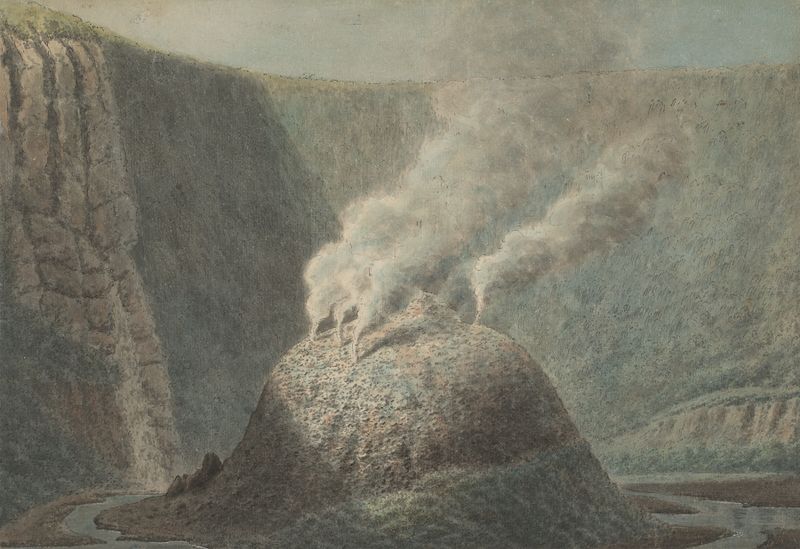
View of the Great Eruption of Morne Soufriere, St. Vincent — History & Facts
The landscape before us whispers of paradise, yet harbors a tumultuous story of decay beneath its vibrant surface. Look to the lush greens in the foreground, where the foliage bursts with life, swirling around the muted browns of ash that hint at what lies beneath. The eruption looms in the background, a towering testament to nature’s ferocity, its smoky tendrils curling into the sky. Notice how the delicate brushwork contrasts the soft sky with the jagged edges of the volcanic mountain, a visual metaphor for beauty often intertwined with chaos.
The artist employs a rich palette that captures both the serenity and the horror of the scene, beckoning the viewer to explore the duality of existence. As you delve deeper, consider the juxtaposition of the tranquil landscape against the violent eruption. The vibrant colors of health and vitality stand in stark contrast to the ashen remnants of destruction that mar the earth. Each stroke conveys a palpable tension, suggesting that what is beautiful can also be perilous.
The interplay of light and shadow further amplifies this conflict, reminding us that even nature’s most breathtaking vistas carry the burden of their own history. Rev. Lansdown Guilding painted this piece during the early 19th century, likely around the time of the eruption that shaped St. Vincent's landscape.
As a clergy member and a naturalist, he was deeply influenced by the Romantic movement, which sought to capture the sublime forces of nature. His work reflects not only a personal journey of discovery but also the broader shifts in artistic expression occurring at a time when nature's power was being redefined by both science and art.