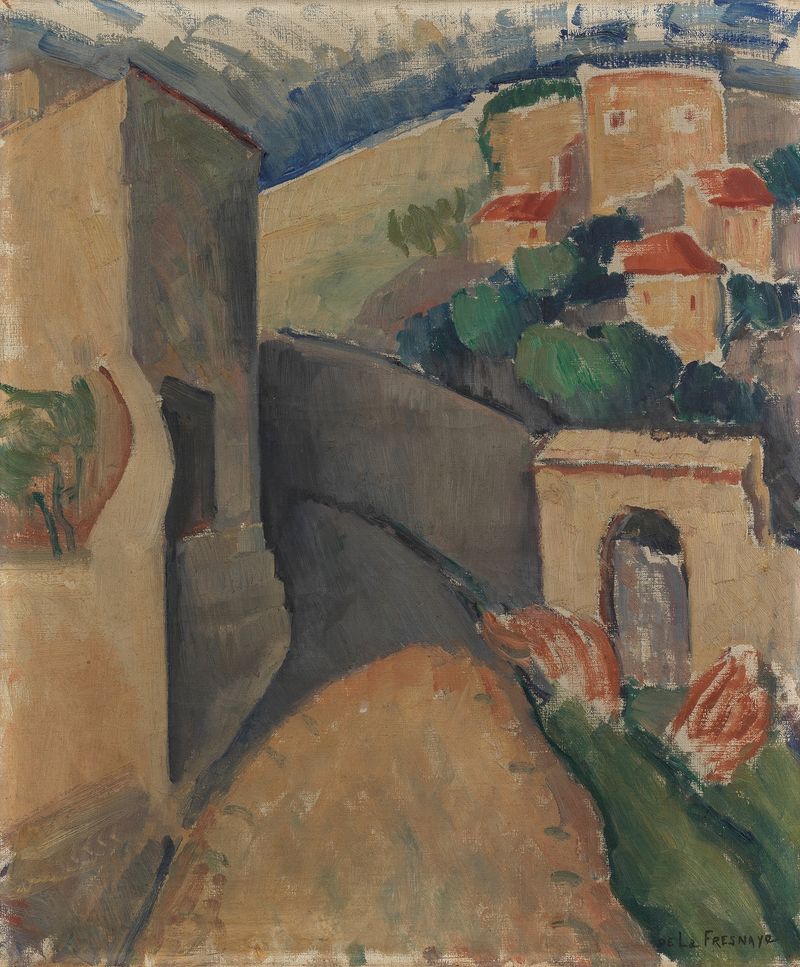
Village at the Water’s Edge — History & Facts
It invites us to peer into a world where illusion dances with reality, echoing the whispers of forgotten dreams. How do we reconcile what we see with what we feel? Look to the lower left corner of the piece, where the tranquil water mirrors the soft hues of the surrounding village, creating an enchanting symmetry. Notice the gentle brushstrokes that blend turquoise and cerulean, evoking a serene calmness that belies the latent tension within.
The geometric shapes of the houses rise against a pale sky, their simple forms suggesting both stability and fragility, while the slanting light caresses the rooftops, highlighting the dichotomy between the idyllic setting and the underlying unease. Hidden in this idyllic tableau, there lies a contrast between the serene water's edge and the angular forms of the village structures. The juxtaposition of soft, fluid lines with rigid geometry suggests a tension between nature and human intervention, inviting viewers to ponder their relationship with both. The cool colors evoke tranquility, yet the standing water hints at stagnation, a precarious balance that captures the essence of an idyllic moment teetering on the brink of change. In 1910, at the heart of a burgeoning modern art movement, the artist painted this piece amidst the rise of Cubism and a shift away from traditional representation.
De La Fresnaye, living in France, was deeply influenced by the avant-garde scene, exploring the interplay of light and form in a rapidly evolving world. This painting reflects his quest to capture not only the visual essence of the village but also the emotional undercurrents that signify transformation.