
Virgin and Child with Saint John the Baptist and Angels — History & Facts
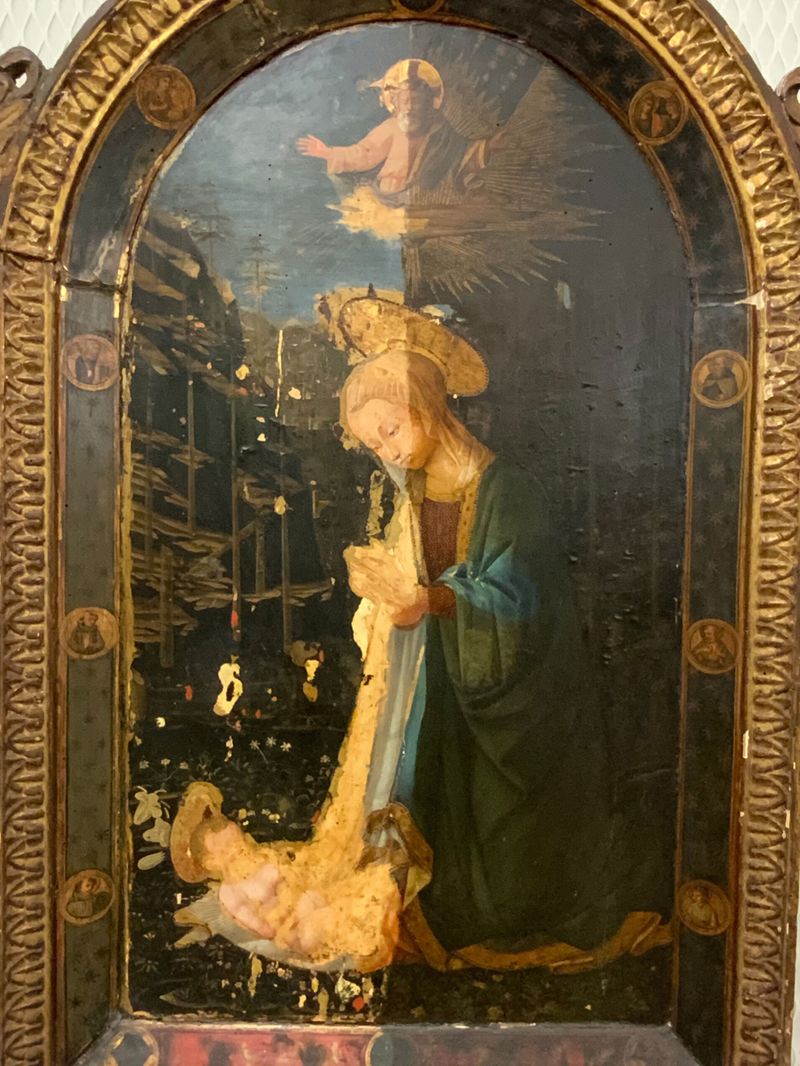
Where does light end, and longing begin? In the delicate interplay of shadow and illumination within this exquisite 15th-century painting, the truth of mortality whispers through each figure’s gaze. Focus first on the radiant figure of the Virgin, her serene expression a beacon of maternal grace. Notice how the soft light envelops her, drawing attention to the tender embrace she shares with the Christ Child, whose tiny hand reaches out as if grasping for understanding. The palette, rich in deep blues and golds, contrasts sharply with the ethereal white of the angels surrounding them, creating a celestial aura that elevates the scene beyond mere earthly existence.
The arrangement of figures guides the eye upward, enhancing the sense of scale and divinity. Yet, amidst this divine portrayal, a poignant tension lurks. The innocent joy of the Child is poignantly juxtaposed with the somber awareness of mortality, hinted at in the distant figure of Saint John the Baptist, who gazes toward the horizon. This duality speaks to the human condition—birth intertwined with the inevitability of loss.
Each angel, with their wistful expressions, seems to echo the unvoiced fears and hopes that accompany life’s fleeting moments. Pseudo Pier Francesco Fiorentino crafted this work in the 15th century, a time when the Renaissance was transforming artistic expression. Working in Florence, he absorbed the influence of his contemporaries while grappling with the spiritual and existential themes of the era. The painting not only reflects a personal exploration of faith and the afterlife but also engages with the broader dialogues of mortality that were prevalent in the art world.
More Artworks by Pseudo Pier Francesco Fiorentino
Browse all →
More Religious Art
Browse all →
The Return of the Prodigal Son
Rembrandt van Rijn

The Garden of Earthly Delights
El Bosco

Count Orgaz’ funeral
El Greco

The Hundred Guilder Print: the central piece with Christ preaching, the plate arched
Rembrandt van Rijn

The Descent from the Cross
Rogier van der Weyden

The return of the prodigal son
Rembrandt van Rijn