Vue de Paestum — History & Facts
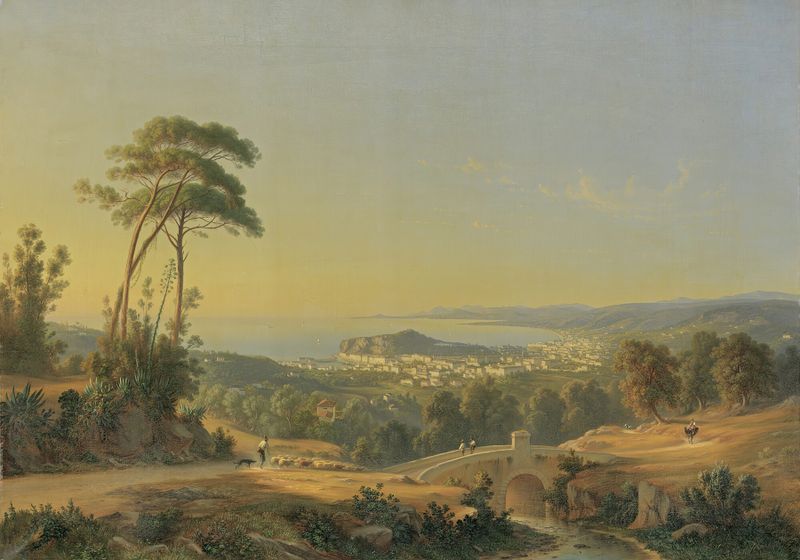
Can paint confess what words never could? Within the delicate strokes of this exquisite piece, an unsettling beauty emerges, whispering stories of decay and the passage of time. Look to the foreground, where sun-dappled ruins rise against a cerulean sky, their weathered surfaces glowing in the embrace of warm light. The columns, though crumbling, stand tall, each crevice and shadow meticulously rendered, revealing the artist's keen eye for detail. Notice how the vibrant greens of the grass contrast with the ochres and grays of the ancient stones, a reminder of nature's tenacity amidst the remnants of human achievement. There is an emotional tension between the vitality of the landscape and the somber decay of the structures.
This juxtaposition speaks to the fragility of civilization, suggesting that beauty, though enduring, is ultimately subject to the inexorable march of time. The soft brushwork and harmonious palette evoke a bittersweet nostalgia, inviting viewers to ponder what is lost and what remains. Each element in the composition harmonizes to create a dialogue between the past and present, urging a deeper reflection on mortality. In 1872, when this piece was created, Johann-Rudolf Bühlmann was deeply immersed in the Romantic tradition, exploring themes of nature and history.
Based in Switzerland, he often drew inspiration from Italy’s classical ruins, reflecting the era's fascination with antiquity. His work was situated within a broader movement that sought to reconcile the beauty of the natural world with the remnants of human endeavor, revealing the complex interplay between creation and decay.