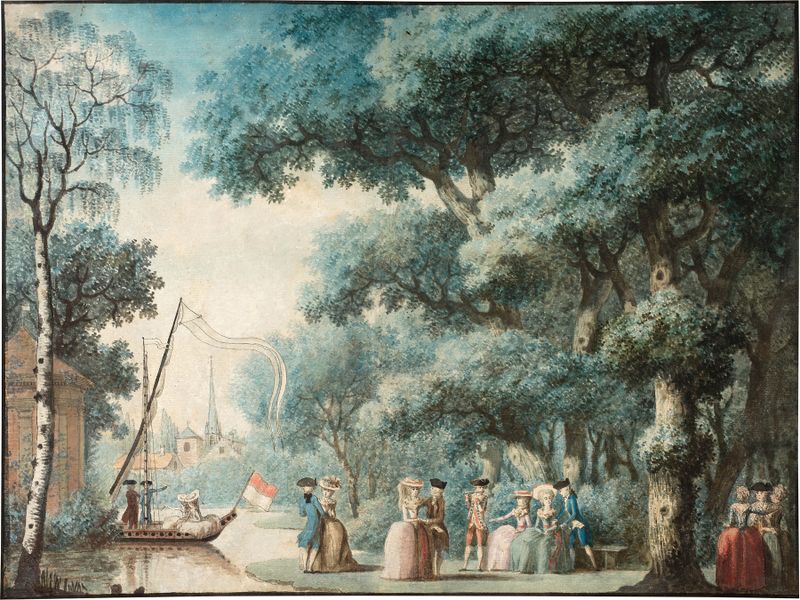
Vue des jardins de Monceau — History & Facts
Could a single brushstroke hold eternity? In Vue des jardins de Monceau, the quiet beauty of an 18th-century garden masks an underlying tension, a whisper of violence hidden within the peacefulness of nature. Look to the left at the delicate foliage, intricately detailed in vibrant greens. The interplay of light and shadow reveals the artist's finesse, drawing your eye towards the elegantly manicured pathways that wind through the garden. Notice the soft blush of roses, their petals almost luminous against the muted earthen tones.
The composition guides the viewer through a serene tableau, yet hints at the meticulous control needed to maintain such beauty. Beneath the surface tranquility lies a contrast between nature’s allure and the chaos it conceals. The very act of cultivation suggests an underlying violence; the careful pruning of branches belies the struggle for control in a wild world. Each stroke speaks to a deeper narrative about human interference in nature, making the viewer question the cost of beauty.
The stark clarity of the scene juxtaposes with the tumultuous emotions that often accompany the act of creation itself. In 1778, as Louis Carrogis Carmontelle painted this piece in Paris, he was immersed in the Enlightenment era, a time marked by philosophical discourse and a fascination with nature's perfection. The gardens of Monceau, a symbol of aristocratic leisure, provided an escape from the political unrest brewing in France. This artwork reflects both a personal sanctuary for the artist and a broader commentary on the society that surrounded him.