
Washington, D.C. — History & Facts
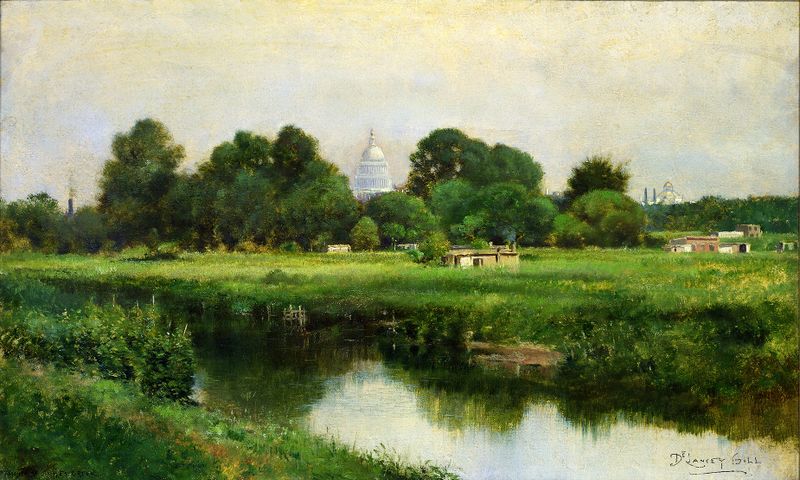
What secret hides in the quiet of the canvas? In a moment where light meets shadow, the stillness of Washington, D.C. invites contemplation of both history and humanity. Look to the center of the composition, where the glistening facade of the White House stands regal against a muted sky. The soft hues of blue and gray envelop the scene, while strategic touches of sunlight illuminate the surrounding trees, casting dappled shadows on the ground. Notice how the artist's brushstrokes capture the essence of the leaves, creating movement that contrasts with the solemnity of the architecture.
This interplay of light and form compels the viewer to traverse not only the landscape but also the nuance of the moment. Within this serene tableau lies a tension between permanence and transience. The grandeur of the building suggests stability and power, yet the gentle light hints at the ephemeral nature of political life and the stories of those who pass by unnoticed. The trees, with their subtle sway, symbolize the whispers of the city—voices of its citizens that often go unheard.
Each element, from the serene sky to the vibrant foliage, reflects the delicate balance between authority and the organic rhythm of life that pulses through the capital. In 1888, De Lancey Gill painted Washington, D.C. during a time when America was grappling with its identity. The post-Civil War era was marked by both reconstruction and the burgeoning of the Gilded Age. As the art world was shifting towards realism and impressionism, Gill’s work emerged as a testament to both the grandeur of national monuments and the quieter, everyday moments that define a city and its people.
More Artworks by De Lancey Gill
Browse all →


More Architecture Art
Browse all →
The statue of Liberty
Frédéric Auguste Bartholdi

View of Houses in Delft, Known as ‘The Little Street’
Johannes Vermeer

View of Houses in Delft, Known as ‘The Little Street’
Johannes Vermeer

The Cathedral in Rouen. The portal, Grey Weather
Claude Monet

The yellow house
Vincent van Gogh

The Church in Auvers-sur-Oise, View from the Chevet
Vincent van Gogh