Yellow Rock, Gloucester — History & Facts
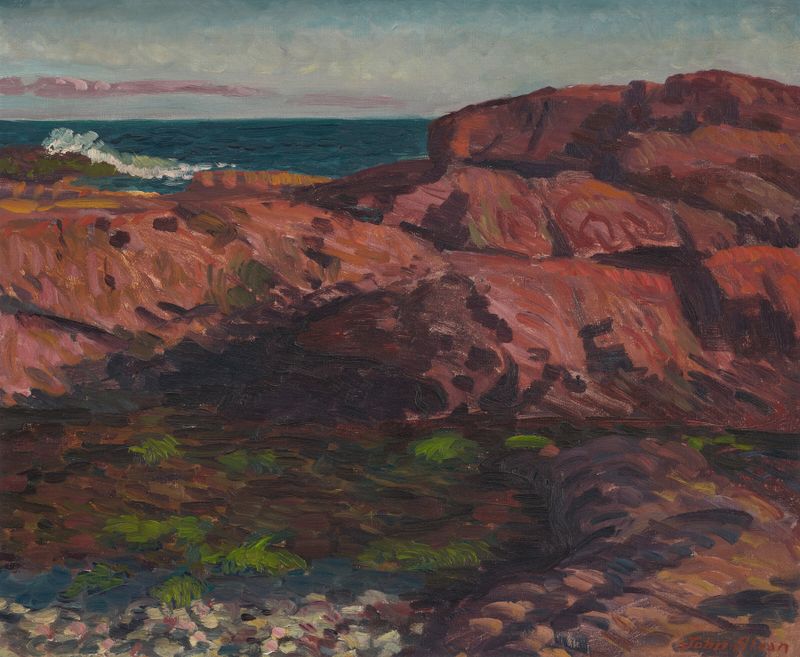
In a time of rising chaos and uncertainty, the act of creation becomes a refuge, a way to capture fleeting moments of beauty and truth amid turmoil. Look to the center of the canvas, where bold strokes of yellow and ochre converge, forming the eponymous rock. The jagged edges and textured surface seem to pulse with energy, while surrounding blues and greens create a vibrant contrast that draws the eye. Notice how the light dances upon the rock, illuminating its contours and casting deep shadows that suggest both depth and mystery.
The artist’s loose brushwork imbues the scene with an immediacy, inviting viewers to feel the live tension of nature’s raw beauty. In this piece, the chaos of the natural world reflects a deeper emotional landscape. The vibrant hues evoke an undercurrent of vitality, yet the solid rock stands resilient, defying the soft chaos of the waves lapping at its base. This juxtaposition encapsulates the artist's struggle against the external tempest of life, embodying a sense of permanence amid impermanence.
Each brushstroke communicates the urgency of existence, a testament to both nature’s relentless beauty and the tumultuous spirit of the time. During 1914, John Sloan painted this work in Gloucester, Massachusetts, a period marked by his exploration of urban and coastal scenes. The world was on the brink of World War I, and Sloan was deeply engaged in the Ashcan School movement, which emphasized realism and the gritty aspects of life. This artwork represents not just a geographical location but also a moment in history when artists sought to convey raw emotion in an increasingly chaotic world.