
Las Meninas Meaning: The Puzzle Behind Velázquez's Major work
Few paintings have sparked as much intrigue as Las Meninas by Diego Velázquez. This enigmatic work, painted in 1599, has been the subject of extensive analysis and debate. Scholars and art lovers alike ponder its complex composition and shifting perspectives. What is the true focus of this painting? Let's explore the layers of meaning in one of Velázquez's most famous paintings.
The Story Behind Las Meninas

Painted in 1599, Las Meninas is a portrait that defies traditional conventions. Commissioned by King Philip IV of Spain, the work was intended to depict his daughter, the Infanta Margarita. However, Velázquez introduces a twist by including himself in the composition, painting the royal family and their entourage in a moment of apparent spontaneity. The painting captures a slice of court life, yet its true subject remains a mystery, inviting viewers to question the nature of observation and representation.
What You See: Composition and Description
At the center of the canvas stands the young Infanta Margarita, her dress gleaming in the light. She is surrounded by her ladies-in-waiting, a pair of dwarfs, and a sleeping dog, creating a lively court scene. To the left, Velázquez himself is depicted in the act of painting, while a mirror in the background reflects the king and queen, adding another layer to the visual puzzle. The painting's complex arrangement of figures and gazes challenges the viewer to consider who is observing whom.
Meaning and Interpretation
The meaning of Las Meninas has been the subject of intense scholarly debate. Some argue that the painting is a commentary on the art of painting itself, with Velázquez asserting his status as a court artist. Others suggest it reflects the power dynamics of the Spanish court, with the Infanta at the center of attention. The mirror's reflection of the king and queen raises questions about reality and representation, making the viewer an active participant in the scene.
Historical Context
Diego Velázquez painted Las Meninas during a period of great political and cultural importance in Spain. As a court painter to King Philip IV, Velázquez had unparalleled access to the royal family and their inner circle. His work reflects the Baroque style's emphasis on realism and complexity, capturing the grandeur and intricacies of the Spanish court. The painting's innovative approach and layered meanings have secured its place as one of the most analyzed works in art history.
Where to See Las Meninas Today
Today, Las Meninas is housed in the Museo del Prado in Madrid, Spain. The museum is renowned for its extensive collection of European art, with Velázquez's works being among its highlights. Visitors can view this iconic painting in person, experiencing firsthand the enigmatic composition and the intricate interplay of figures and reflections.
Related Works: Prince Baltasar Carlos in Silver

Another notable work by Velázquez is Prince Baltasar Carlos in Silver, which depicts the young prince in a striking silver outfit. This portrait showcases Velázquez's skill in capturing the dignity and status of his royal subjects. The use of light and shadow in this painting enhances the three-dimensional quality of the figure, a hallmark of Velázquez's Baroque style.
Related Works: Juan de Pareja
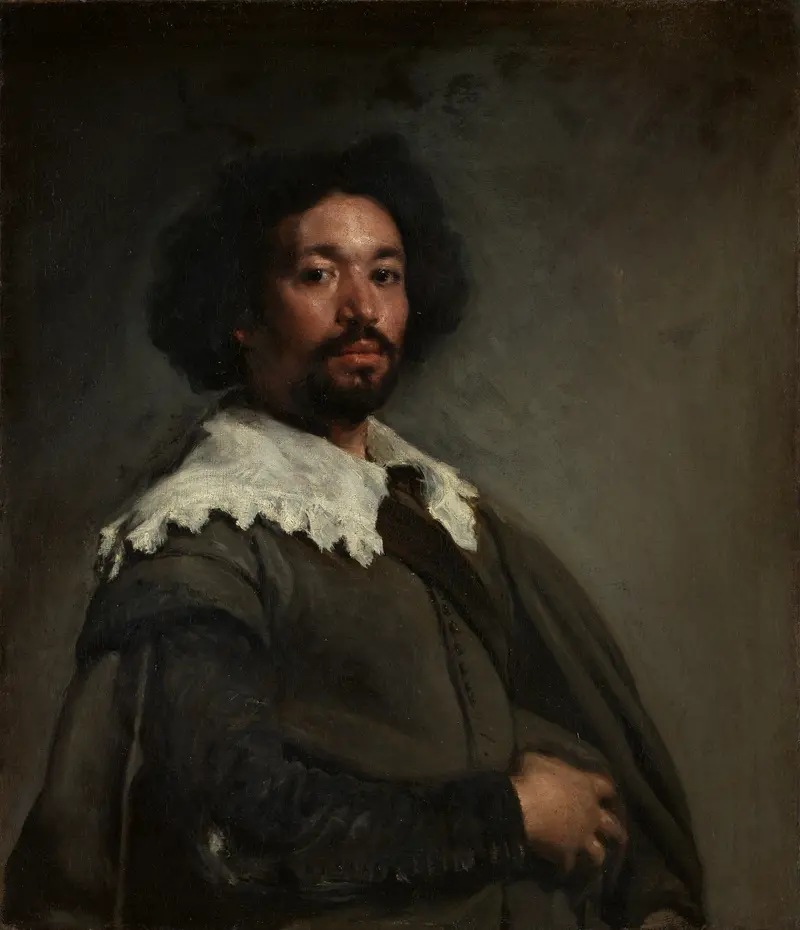
Velázquez's Juan de Pareja is another significant portrait, capturing the likeness of his assistant with remarkable detail. The painting's rich, earthy tones and the subject's direct gaze create a sense of intimacy, demonstrating Velázquez's mastery of portraiture. This work, like Las Meninas, reflects the artist's ability to convey depth and character through his use of light and texture.
Diego Velázquez's Las Meninas continues to captivate and challenge viewers with its complex composition and layered meanings. To explore this major work and other works by Velázquez, download high-resolution images for free on FineArtFree.