
Arco di Sant’Eligio — History & Facts
In the depths of the canvas, echoes of legacy linger, whispering stories waiting to be unveiled. Each stroke is a bridge between the ephemeral and the eternal, urging us to explore what has been lost yet remains indelibly etched in our collective memory. Focus first on the archway, a commanding presence that draws the eye with its intricate details and rich textures. The play of light across its surface reveals not just the structure itself, but the passage of time that has sculpted it.
Notice how the warm earth tones embrace the cool shadows that caress the edges, creating a dialogue between warmth and distance, familiarity and curiosity. The juxtaposition invites the viewer to appreciate the transient beauty of decay and the steadfastness of history woven into the fabric of the scene. As you delve deeper into the composition, hidden meanings emerge from the contrast between the arch's sturdy form and the soft, almost ghostly figures that dance in its vicinity. These figures, perhaps a reflection of the past's fleeting nature, serve as a poignant reminder of all that has come before.
The arch stands as a guardian, preserving memories that may otherwise fade, while the figures grasp at the remnants of a world long gone, caught in the tension between remembrance and oblivion. During the time Arco di Sant’Eligio was created, Vincenzo Migliaro was deeply entrenched in the cultural currents of late 19th-century Italy, marked by a burgeoning sense of national identity and artistic revival. The era celebrated realism and the human experience, as artists sought to capture the essence of life and the remnants of history that framed it. Migliaro, amidst this vibrant landscape, crafted works that paid homage to the past while inviting viewers to reflect on their own legacies.
More Artworks by Vincenzo Migliaro
Browse all →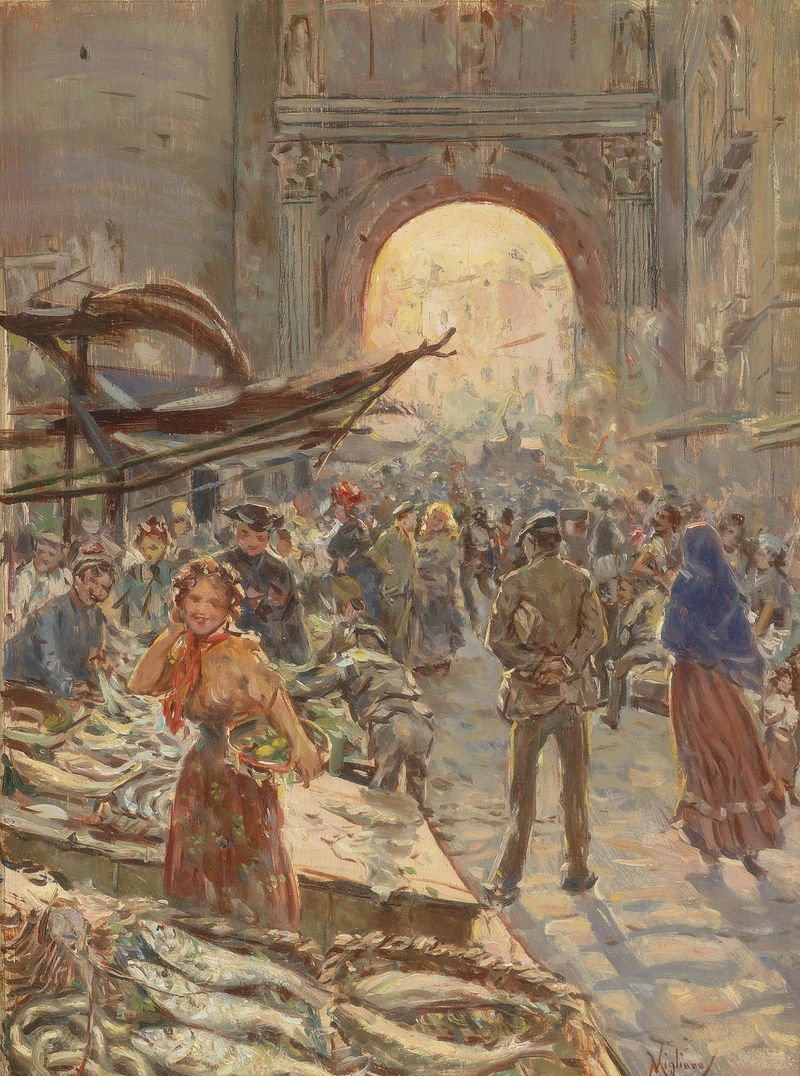
More Architecture Art
Browse all →
The statue of Liberty
Frédéric Auguste Bartholdi

View of Houses in Delft, Known as ‘The Little Street’
Johannes Vermeer

View of Houses in Delft, Known as ‘The Little Street’
Johannes Vermeer

The Cathedral in Rouen. The portal, Grey Weather
Claude Monet

The yellow house
Vincent van Gogh

The Church in Auvers-sur-Oise, View from the Chevet
Vincent van Gogh