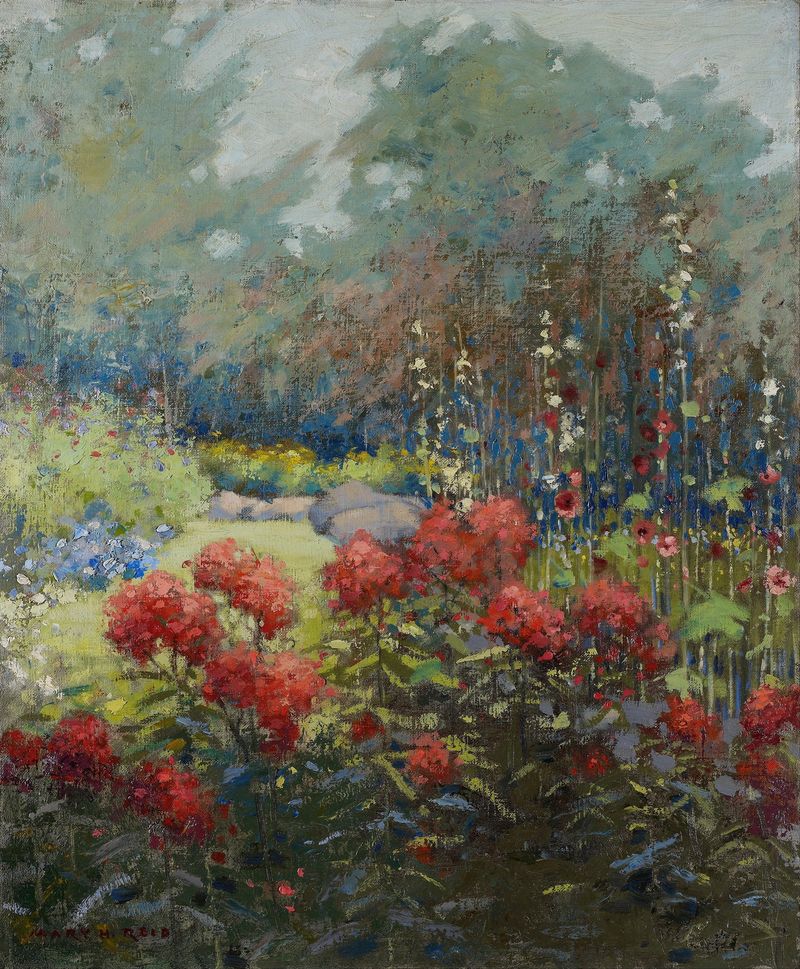
At Twilight, Wychwood Park — History & Facts
As twilight descends, the world transforms, cloaking familiar landscapes in a veil of ethereal colors and soft shadows. This moment, suspended between day and night, captures the profound metamorphosis that accompanies nature’s rhythm. Look to the left at the trees, their silhouettes nearly dissolving into the indigo sky, while the faint glow of the horizon beckons from the right. Notice how the artist employs a palette of rich purples and deep blues, contrasted by bursts of warm orange and yellow.
The impressionistic strokes convey not just motion but emotion, inviting viewers to feel the gentle shift from light into darkness. Each layer of paint seems to breathe life into the scene, blending the tangible with the intangible. Delve deeper into the nuances of this composition, where the trees stand as guardians, both sheltering and obscuring the light. The interplay between shadow and the remaining daylight reflects the tension of transformation—the inevitable passage from vibrancy to somberness.
This cycle speaks to a universal experience, where endings are but preludes to new beginnings, urging contemplation of what lies beyond the visible. Created during the early 20th century, At Twilight, Wychwood Park emerged from a period when Mary Hiester Reid was exploring her artistic identity amid a rapidly changing world. Painted between 1906 and 1916 in a time marked by cultural shifts and the rise of modernism, Reid’s work resonates with personal and broader societal transformations, capturing a fleeting moment in nature that invites deeper reflection on existence itself.