
Atrio contiguo alla reggia di Ceruone — History & Facts
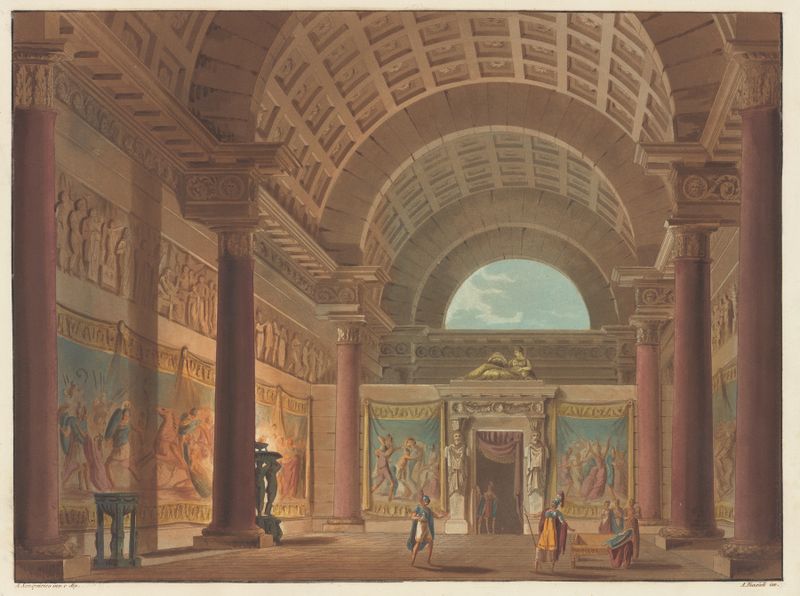
Did the painter know this moment would outlive them? In Atrio contiguo alla reggia di Ceruone, the viewer is drawn into a meticulously crafted world, a dialogue between the past and the present, frozen in time yet pulsating with life. Look to the center of the canvas, where a grand archway beckons, framed by lush greenery that spills over its edges. The warm hues of ochre and soft blues create an atmosphere of serenity, inviting you to step into this harmonious setting. Notice how the light filters through the foliage, casting dappled shadows upon the stone pathway.
This careful play of light and shadow not only defines the architectural grandeur but also evokes a sense of nostalgia for what once was. Delve deeper into the intricate details: the delicate carvings that adorn the archway hint at stories untold, while the solitary figure in the foreground appears contemplative, lost in thought. The contrast between the solidity of the stone and the ephemeral nature of the figure speaks to a broader theme of permanence versus transience, urging viewers to reflect on their place within the flow of history. Alessandro Sanquirico painted this work in 1812, during a time when neoclassicism was giving way to romanticism in the art world. Living in Milan, he was deeply influenced by his surroundings, as politically charged events unfolded in Italy.
This period marked a transition in both his style and the broader artistic landscape, as artists began to explore emotional depth and personal expression, capturing not just the physical world but the human experience as well.
More Artworks by Alessandro Sanquirico
Browse all →
More Architecture Art
Browse all →
The statue of Liberty
Frédéric Auguste Bartholdi

View of Houses in Delft, Known as ‘The Little Street’
Johannes Vermeer

View of Houses in Delft, Known as ‘The Little Street’
Johannes Vermeer

The Cathedral in Rouen. The portal, Grey Weather
Claude Monet

The yellow house
Vincent van Gogh

The Church in Auvers-sur-Oise, View from the Chevet
Vincent van Gogh