Baumgruppe — History & Facts
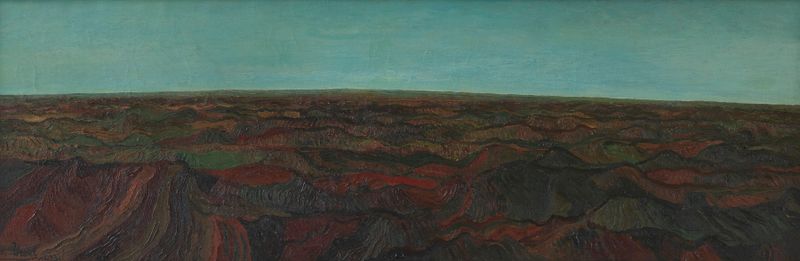
Can paint confess what words never could? In Baumgruppe, the chaos of nature and emotion intertwine, revealing what lies beneath the surface of everyday life. Focus on the tumultuous forms converging in the center of the canvas, where chaotic branches claw at one another like emotions battling for dominance. The artist employs a palette of dark greens and browns, juxtaposed with bursts of light that flicker like hope amidst turmoil. Notice how the tension is heightened by the swirling brushstrokes, leading the eye into a dense thicket of foliage that feels alive, almost as if it breathes. Hidden within this tangled mass are symbols of struggle and resilience.
The gnarled limbs suggest a fight against the winds of fate, while the lighter hues represent fleeting moments of clarity. This dichotomy invites the viewer to explore the duality of existence—how chaos can coexist with moments of beauty and serenity. The overlapping layers of paint create a textured surface that echoes the complexity of life, encouraging deeper reflection with each glance. Josef Scharl painted Baumgruppe in 1934, during a turbulent time in Germany's political landscape.
He was immersed in the vibrant yet often oppressive atmosphere of the Weimar Republic, which influenced his artistic vision. This period marked a significant turning point in his career, as he began to blend surrealism with expressionism, capturing the disquiet of his surroundings through a unique lens.