Hügelige Landschaft — History & Facts
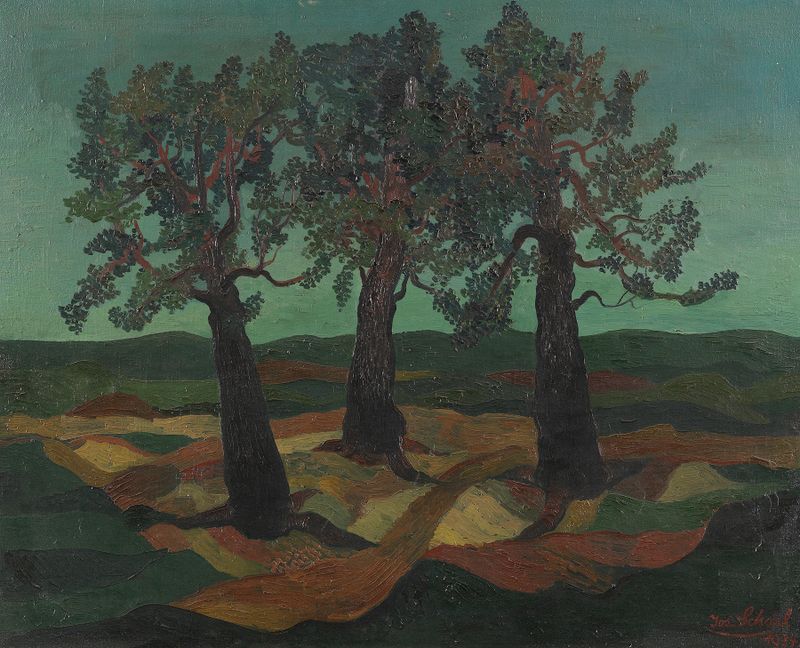
Is this a mirror — or a memory? In Hügelige Landschaft, the viewer is drawn into a dreamscape where reality blurs with the infinite possibilities of the imagination. Richly layered hills roll across the canvas, evoking a sense of nostalgia while simultaneously inviting contemplation of that which has yet to be discovered. Focus first on the undulating hills that dominate the scene, their soft curves and vibrant greens contrasting against the deep, cerulean sky. Notice how the artist employs a palette of muted pastels, creating a harmonious interplay of light and shadow that breathes life into the landscape.
The gentle brushstrokes convey a sense of both movement and stillness, reflecting the rhythm of nature as if each hill whispers secrets from a time long ago. As you delve deeper, consider the emotional resonance hidden within the undulating forms. The hills appear almost anthropomorphic, suggesting a connection to the human experience — a landscape that mirrors internal struggles and joys. This subtle anthropomorphism invites viewers to explore their own memories and dreams, as if the hills stand sentinel to our innermost thoughts, bridging the divide between the conscious and the subconscious. Painted in 1933 during a tumultuous period of artistic evolution in Europe, the work reflects Scharl’s transition toward a more expressive use of color and form.
Living in Germany at the time, he was influenced by the rise of modernism and the shifting cultural landscape. His exploration of surrealism and abstraction marked a critical moment in his career, pushing the boundaries of traditional landscape painting while capturing the tumult of his era.