Buchenwald am Ganszipfel (Chiemsee) — History & Facts
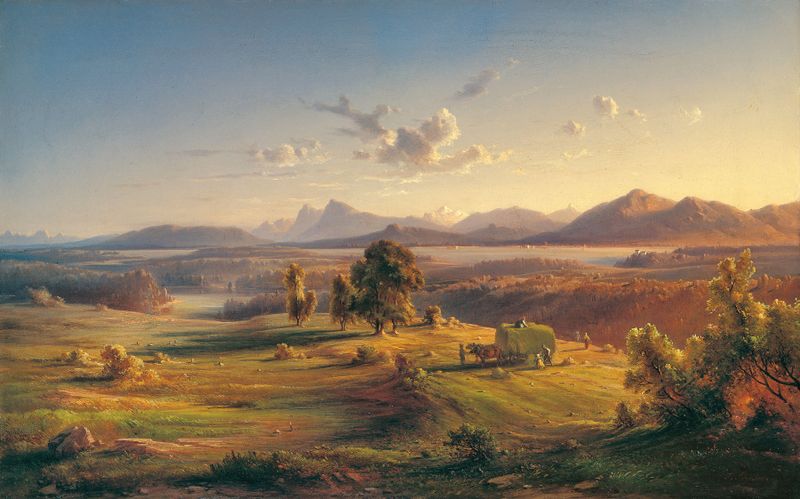
Can beauty exist without sorrow? In Buchenwald am Ganszipfel (Chiemsee), Felix von Schiller explores this paradox through a landscape that captivates and disturbs the heart. The serene lake reflects a tranquil sky, yet beneath its picturesque surface lies an undercurrent of obsession that shapes the viewer's connection to nature. Look closely at the foreground, where towering birch trees rise majestically, their white bark contrasting against the deep greens of the underbrush. The gentle ripples on the water’s surface respond to the morning light, casting shimmering reflections that dance like ghosts.
The cool palette of blues and greens draws the eye, creating a sense of calmness, while the distant mountains loom, almost ominous, hinting at the sublime—an ever-present reminder of nature’s duality. There’s a tension between the serene beauty of the scene and the subtle hints of melancholy. The pristine lake, so inviting, may conceal depth beyond what is visible, echoing the obsession one can feel for both love and nature. The light filtering through the trees illuminates the delicate interplay of life and decay, suggesting that every moment of beauty is tinged with the inevitability of loss.
Schiller’s work prompts us to ponder how our connections to the natural world can be both uplifting and haunting. In 1843, Felix von Schiller painted this piece while residing in Bavaria, a region steeped in romantic ideals and nostalgia for the past. This was a time when the burgeoning art movement sought to capture the essence of landscapes, revealing complex emotions through nature. Schiller's work reflects a personal exploration during a period of artistic evolution, marking the transition toward a deeper understanding of the relationship between man and the environment.