Burgruine (Ruins Of A Castle) — History & Facts
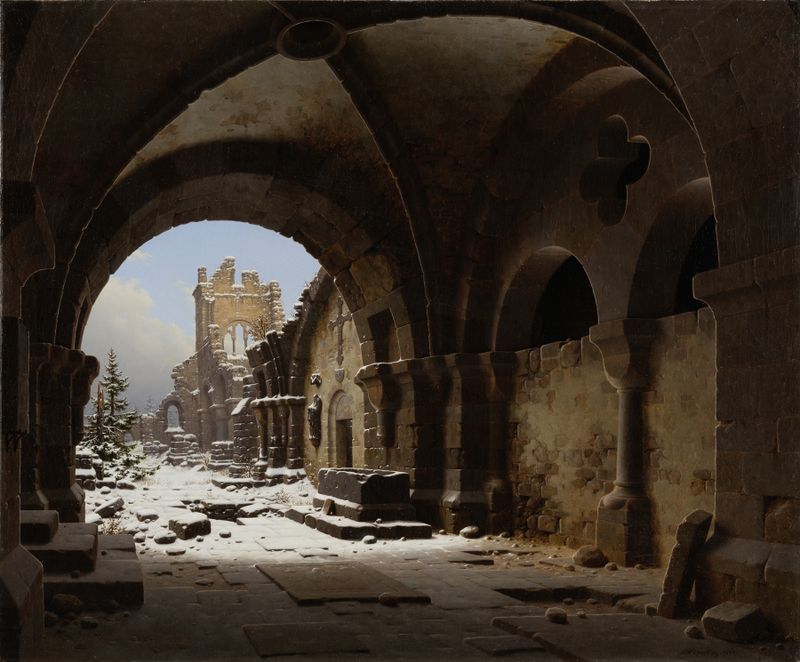
Could beauty survive in a century of chaos? The ruins of a castle, both majestic and melancholic, stand as a testament to the passage of time and the fragility of innocence. Here, amidst the remnants of stone and greenery, lies a haunting echo of what once was, inviting contemplation and reflection. Focus your gaze on the crumbled walls that dominate the canvas, their weathered texture telling stories of forgotten battles and quiet moments. The interplay of light and shadow draws attention to the foreground, where delicate tendrils of ivy weave through the stones, contrasting the hard edges of decay with the gentle persistence of nature.
Notice how the artist employs a muted palette, the soft greens and browns evoking an atmosphere of tranquility despite the ruins’ somber history. Within this artwork lies a poignant contrast: the resilience of nature versus the transience of human endeavor. The vibrant plant life that flourishes among the cold stones represents hope and renewal, suggesting that while human creations may fall, nature continues to thrive. The ruins themselves embody the innocence lost, a reminder of the impermanence of beauty and the inevitability of time.
Each detail, from the worn battlements to the distant hills, speaks to a once-vibrant life overshadowed by the quiet march of history. During 1848, when this piece was created, Hasenpflug was deeply engaged in the Romantic movement in Germany, a period marked by a profound interest in nature and the sublime. The socio-political upheaval of his time, characterized by revolutions and calls for reform, likely influenced his choice to depict a solitary ruin, reflecting both the beauty and sorrow of a world in transition. In capturing this moment, he invites viewers to ponder the enduring power of nature and the echoes of innocence that persist despite the chaos surrounding them.