
Caprice de ruines antiques — History & Facts
Who listens when art speaks of silence? In the stillness of Caprice de ruines antiques, an intricate whisper of obsession unfolds, beckoning the viewer into a world where nostalgia and decay intertwine. Look to the center of the composition where the majestic ruins rise, their weathered stones almost breathing with history. The soft, muted palette of earth tones harmonizes with gentle strokes that evoke a sense of reverence. Notice how the light plays delicately across the surfaces, illuminating intricate details of the architecture while casting long, contemplative shadows.
This careful balance between light and dark reveals the artist's intent to evoke a poignant dialogue between past grandeur and present ruin. Upon closer examination, the emotional tension between nature and mankind emerges. Tendrils of ivy creep over the crumbling columns, representing both the relentless advance of time and the beauty found in decay. The solitary figure in the foreground, seemingly lost in thought, embodies an obsession with the past, inviting the viewer to ponder their own relationship with history.
The juxtaposition of man against monumental structures encapsulates the fleeting nature of existence. Created in the 18th century, this work reflects Charles Louis Clérisseau's deep fascination with classical architecture and his role in the burgeoning neoclassical movement. During this time, interest in ancient ruins surged across Europe, spurred by archaeological discoveries and a thirst for the wisdom of antiquity. Clérisseau's meticulous rendering of these ruins not only showcases his technical skill but also embodies an era captivated by the echoes of history and the stories they tell.
More Artworks by Charles Louis Clérisseau
Browse all →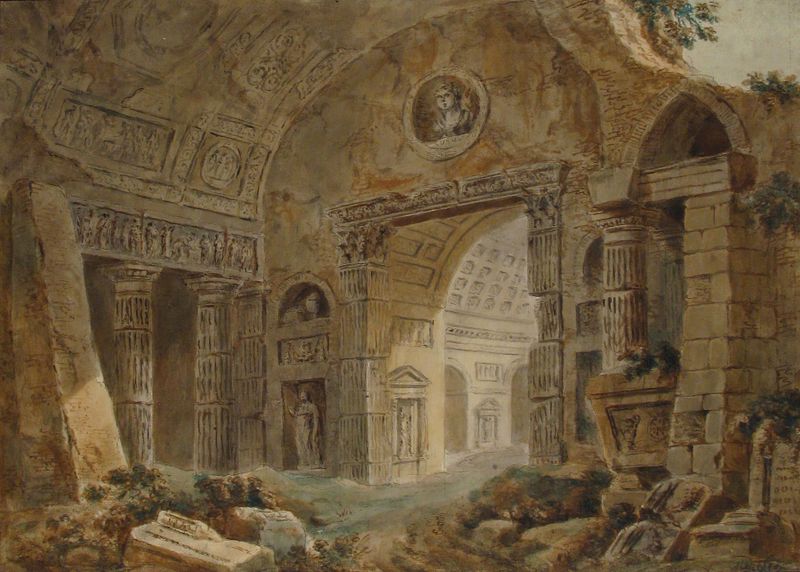
More Architecture Art
Browse all →
The statue of Liberty
Frédéric Auguste Bartholdi

View of Houses in Delft, Known as ‘The Little Street’
Johannes Vermeer

View of Houses in Delft, Known as ‘The Little Street’
Johannes Vermeer

The Cathedral in Rouen. The portal, Grey Weather
Claude Monet

The yellow house
Vincent van Gogh

The Church in Auvers-sur-Oise, View from the Chevet
Vincent van Gogh