
Cathedral In Segovia — History & Facts
In the realm of art, few expressions capture the essence of ecstasy as profoundly as this. It beckons us to explore the depth of emotion embedded in captured moments, urging us to reflect on the sacred intersections of light and stone. Look towards the towering spires that punctuate the skyline, their delicate silhouettes rendered with meticulous care. The artist employs a symphony of warm and cool hues, blending them into a rhythmic dance that evokes the interplay of sunlight and shadow across the cathedral’s façade.
Notice how the gentle curves of the architecture cradle the ethereal light, creating a sacred aura that envelops the viewer almost like a whispered prayer. Each brushstroke, deliberate and precise, invites you to wander through the structured chaos of faith and artistry. Amidst the grandeur, subtle contrasts emerge—between the soaring heights of the cathedral and the grounding presence of the earthly landscape. This juxtaposition speaks to a tension between aspiration and reality, mirroring the human longing for transcendence.
The interplay of vibrant colors against the monochrome backdrop of the sky conjures a dialogue between joy and melancholy, a reminder of the bittersweet nature of existence. Here, ecstasy is not merely celebration; it is a yearning, a pursuit of the divine captured in tangible form. Created in a time when the world was beginning to embrace modernity, the artist worked amid a rich tapestry of artistic movements. Friedrich Eibner navigated both the shadows of Romanticism and the emerging influences of the avant-garde.
This piece emerged in a period marked by intense exploration of emotion, spirituality, and the relationship between man and the divine, reflecting a personal and cultural quest for meaning in an ever-changing world.
More Artworks by Friedrich Eibner
Browse all →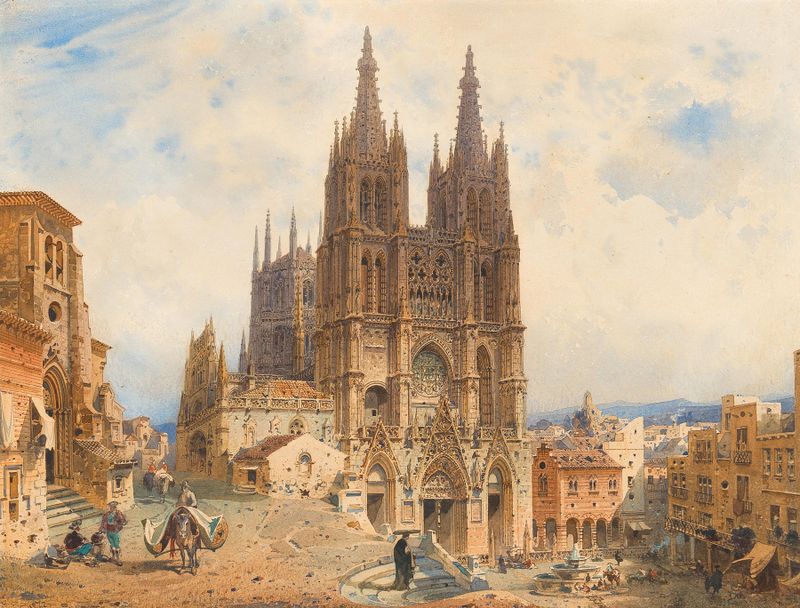
More Architecture Art
Browse all →
The statue of Liberty
Frédéric Auguste Bartholdi

View of Houses in Delft, Known as ‘The Little Street’
Johannes Vermeer

View of Houses in Delft, Known as ‘The Little Street’
Johannes Vermeer

The Cathedral in Rouen. The portal, Grey Weather
Claude Monet

The yellow house
Vincent van Gogh

The Church in Auvers-sur-Oise, View from the Chevet
Vincent van Gogh