
Chantiers de démolition de la rue des Billettes, 1888 — History & Facts
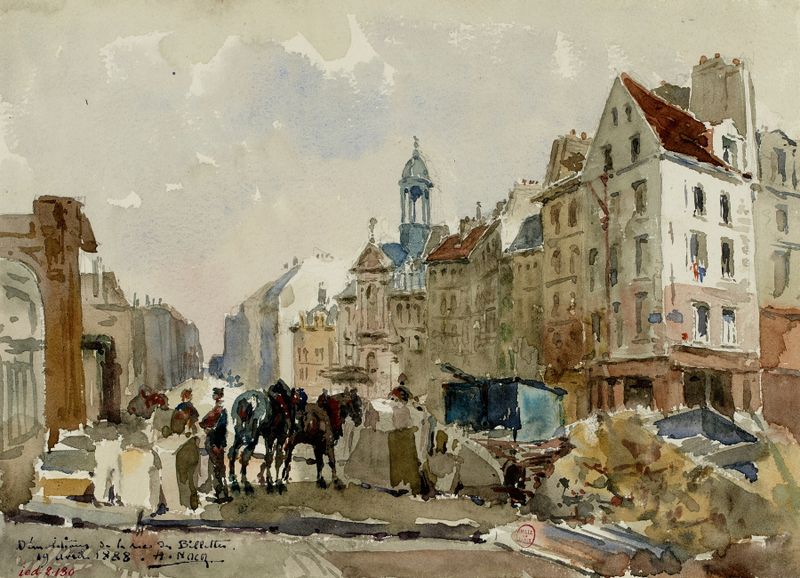
In Chantiers de démolition de la rue des Billettes, light becomes a haunting witness to the passage of time, illuminating both decay and hope in the urban landscape. Look closely at the interplay of shadows and sunlight; the way the harsh light sculpts the crumbling facades, revealing the textures of time on weathered bricks. Notice how the delicate strokes guide your gaze from the workers laboring at the forefront to the skeletal structures behind them, a subtle commentary on progress and loss. Nocq’s choice of a muted palette emphasizes the somber atmosphere of demolition, transforming mundane materials into a poignant narrative of change. Beneath the surface, the painting reflects the emotional weight of urban transformation.
The juxtaposition of industrious figures against the ruins suggests a tension between human endeavor and the inevitable march of time. Each worker embodies resilience, yet they are surrounded by remnants of a past that is rapidly vanishing, prompting a meditation on nostalgia and progress. This duality underscores the fragility of existence amidst urban evolution, urging viewers to consider what is sacrificed in the name of development. Created in the late 19th century, Nocq painted this piece during a time of significant architectural and societal change in Paris, where modernization clashed with traditional forms.
In this era, as the city was experiencing rapid industrialization, artists often grappled with themes of memory and absence, capturing the essence of a city on the brink of reinvention. The artist’s focus on demolition reflects not just architectural shifts, but a cultural moment marked by the tension between heritage and the relentless drive of modernity.
More Artworks by Henry Eugène Nocq
Browse all →
More Architecture Art
Browse all →
The statue of Liberty
Frédéric Auguste Bartholdi

View of Houses in Delft, Known as ‘The Little Street’
Johannes Vermeer

View of Houses in Delft, Known as ‘The Little Street’
Johannes Vermeer

The Cathedral in Rouen. The portal, Grey Weather
Claude Monet

The yellow house
Vincent van Gogh

The Church in Auvers-sur-Oise, View from the Chevet
Vincent van Gogh