
City with viaduct — History & Facts
Can paint confess what words never could? In City with Viaduct, the intricate interplay of structure and abstraction evokes a profound sense of transformation, inviting viewers to explore their own interpretations. Look to the right at the bold, geometric forms that rise and cascade throughout the canvas. The viaduct stretches across the scene, a powerful symbol of connectivity, its arches rendered with sharp lines and muted tones that suggest both strength and fragility. The palette of earthy browns and grays contrasts with vibrant splashes of color that hint at life beneath the surface—a city teeming with unseen stories.
Notice how the light dances across the composition, creating a dynamic tension between shadow and illumination, guiding your gaze along the winding paths that crisscross the image. Beneath this urban façade lies a deeper narrative of change and progress. The viaduct, emblematic of modernity, juxtaposes the organic shapes of the surrounding buildings, reflecting the struggle between nature and human intervention. Small details, like the billowing clouds above, hint at the passage of time, while the rhythm of the lines suggests a continuous movement, mirroring the ever-evolving landscape of urban life.
The painting encapsulates both the optimism and anxiety that accompanies transformation, challenging viewers to confront their own relationship with progress. Louis Marcoussis created this work in 1930, during a pivotal moment in European art history marked by the rise of modernism and abstraction. Living in Paris, he was influenced by cubism and the shifting dynamics of city life, which informed his exploration of perspective and form. This painting reflects his engagement with contemporary themes and his desire to capture the essence of a rapidly changing world through innovative techniques and vibrant compositions.
More Artworks by Louis Marcoussis
Browse all →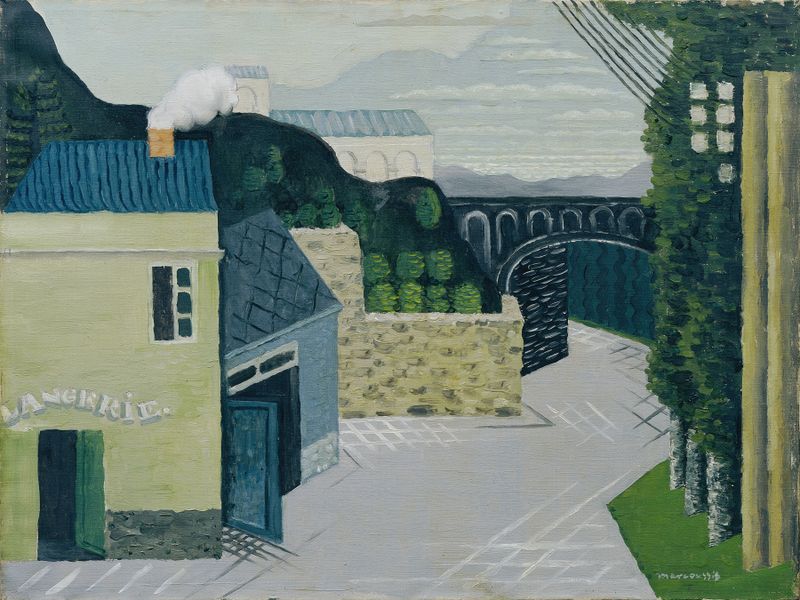
More Architecture Art
Browse all →
The statue of Liberty
Frédéric Auguste Bartholdi

View of Houses in Delft, Known as ‘The Little Street’
Johannes Vermeer

View of Houses in Delft, Known as ‘The Little Street’
Johannes Vermeer

The Cathedral in Rouen. The portal, Grey Weather
Claude Monet

The yellow house
Vincent van Gogh

The Church in Auvers-sur-Oise, View from the Chevet
Vincent van Gogh