
Stadt mit Viadukt — History & Facts
Who listens when art speaks of silence? In Stadt mit Viadukt, movement echoes through stillness, breathing life into a cityscape that teeters on the edge of abstraction. Look to the lower left corner at the delicate forms of buildings merging into one another, their sharp lines softened by the muted tones of gray and ochre. The viaduct arches gracefully across the canvas, a bold gesture of architectural ambition. Notice how the interplay of light and shadow creates a rhythmic dance, guiding your gaze from the foreground into the depths of the scene, where jagged shapes and subtle curves meet in a harmonious balance. Beneath the surface, contrasts emerge—the solidity of the viaduct juxtaposed with the fluidity of the surrounding structures speaks to the tension between stability and transience.
The muted palette, punctuated by the occasional burst of color, conveys a palpable sense of urban life, yet the absence of human figures amplifies the feeling of solitude. It invites contemplation on the stories held within these silent structures, while the composition itself seems to pulse with the unsung energy of a city alive with movement. In 1930, while living in Paris, Marcoussis created this work amidst the tumult of pre-war Europe, where the rapid advancement of modernity clashed with lingering echoes of tradition in art. This period saw the rise of Cubism and an exploration of new forms, with the artist experimenting with collage and the dynamics of perspective.
Stadt mit Viadukt reflects not only his personal style but also the zeitgeist of an era on the brink of unprecedented change.
More Artworks by Louis Marcoussis
Browse all →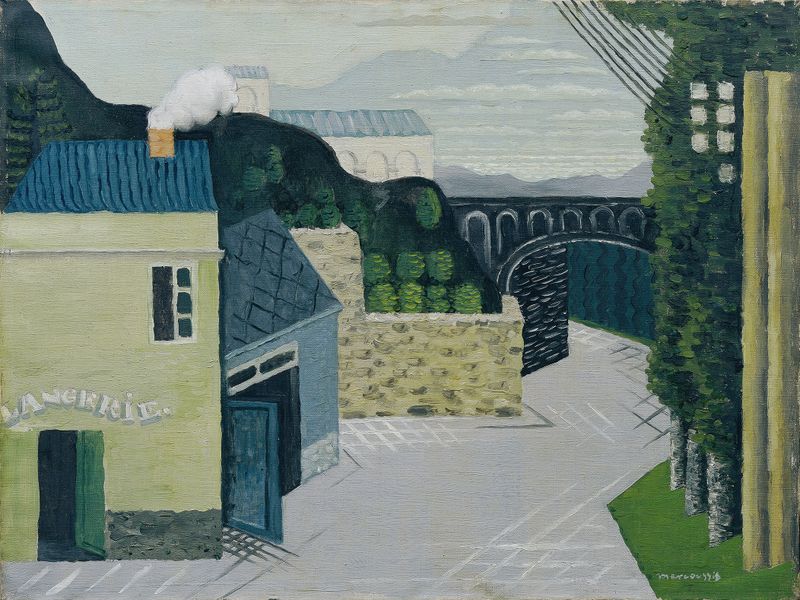
More Architecture Art
Browse all →
The statue of Liberty
Frédéric Auguste Bartholdi

View of Houses in Delft, Known as ‘The Little Street’
Johannes Vermeer

View of Houses in Delft, Known as ‘The Little Street’
Johannes Vermeer

The Cathedral in Rouen. The portal, Grey Weather
Claude Monet

The yellow house
Vincent van Gogh

The Church in Auvers-sur-Oise, View from the Chevet
Vincent van Gogh