Coucher de soleil en Hollande — History & Facts
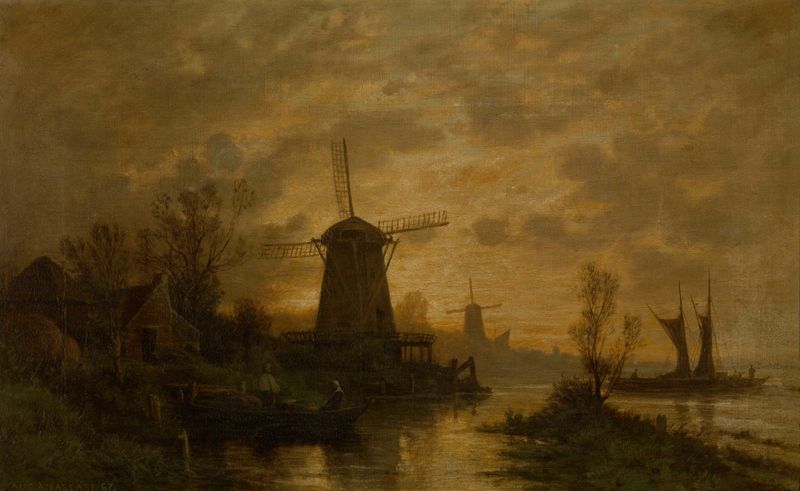
Can beauty exist without sorrow? In Coucher de soleil en Hollande, this question lingers like the fading light of day, hinting at the void that often accompanies transcendent moments. A sunset can evoke both wonder and melancholy, a duality that resonates deeply within the human experience. Look to the horizon where the sun melts into a palette of fiery oranges and soft purples, drawing your gaze into the vibrant, yet fleeting beauty of twilight. The painter's brushstrokes capture the gentle ripples of water below, its surface mirroring the sky’s transformation while simultaneously reflecting a sense of calm.
Notice the silhouettes of distant windmills standing sentinel against the horizon, their sturdy forms grounding the ethereal scene in reality. Each color choice and meticulous detail magnifies the artist’s intent to portray not just a landscape, but an emotional landscape suspended between day and night. The interplay between light and shadow masterfully conveys a tension that invites contemplation on transience and permanence. The radiant sky suggests a moment of joy, while the darkening water hints at the inevitable approach of night, evoking a sense of loss that accompanies beauty.
This contrast encapsulates the duality of existence, reminding us that profound beauty is often tinged with a sense of longing or absence—a void that colors our perception of joy. Auguste Anastasi created this exquisite work in 1857 while in France. At that time, artists were exploring the interplay of light in nature, influenced by the burgeoning Impressionist movement, even as they were grounded in more traditional techniques. This period marked a pivotal moment for landscape painting, as artists like Anastasi sought to capture ephemeral moments, bridging the gap between Romanticism and modernity, reflecting the shifting dynamics of both art and society.