
Court Yard of Caerlaverock Castle — History & Facts
Could a single brushstroke hold eternity? In the tranquil yet poignant depiction of a forgotten space, decay whispers the stories of time, asking us to confront the beauty found in impermanence. Look to the foreground where the crumbling stones of Caerlaverock Castle emerge from the canvas, bathed in an ethereal light that hints at a once-glorious past. The artist's meticulous attention to texture captures the way age has etched itself onto the structures, making every fissure a testament to time’s passage. A muted palette of grays and greens imbues the scene with a melancholic serenity, drawing the eye toward the delicate interplay between shadow and light that speaks of life lingering in what remains. Within the decaying walls lies a profound commentary on resilience and the transitory nature of existence.
The juxtaposition between the sturdy castle stones and the encroaching wild undergrowth evokes a struggle between human creation and nature’s relentless reclamation. Each element prompts reflection on what endures and what fades, inviting viewers to contemplate their own relationship with time and memory, while the castle stands as both guardian and grave of history. In 1848, Robert William Billings created this evocative piece during a period of profound change in the art world, marked by a growing interest in capturing the sublime qualities of nature and architecture. Living in a time of industrial advancement, he turned his gaze toward the past, chronicling the remnants of medieval structures in Scotland.
This painting emerged at a moment when artists were beginning to explore the themes of nostalgia and decay, paving the way for future movements that would delve deeper into the relationship between humanity and the passage of time.
More Artworks by Robert William Billings
Browse all →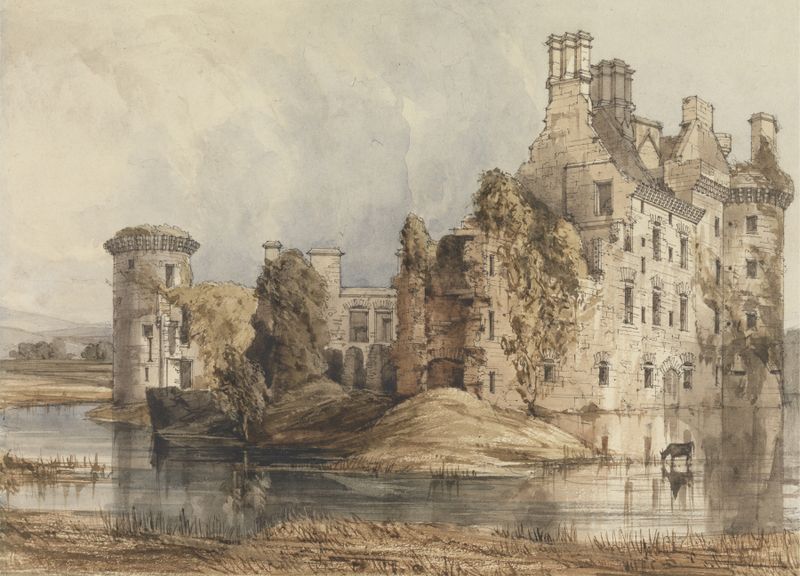
More Architecture Art
Browse all →
The statue of Liberty
Frédéric Auguste Bartholdi

View of Houses in Delft, Known as ‘The Little Street’
Johannes Vermeer

View of Houses in Delft, Known as ‘The Little Street’
Johannes Vermeer

The Cathedral in Rouen. The portal, Grey Weather
Claude Monet

The yellow house
Vincent van Gogh

The Church in Auvers-sur-Oise, View from the Chevet
Vincent van Gogh