Dalles of St. Louis — History & Facts
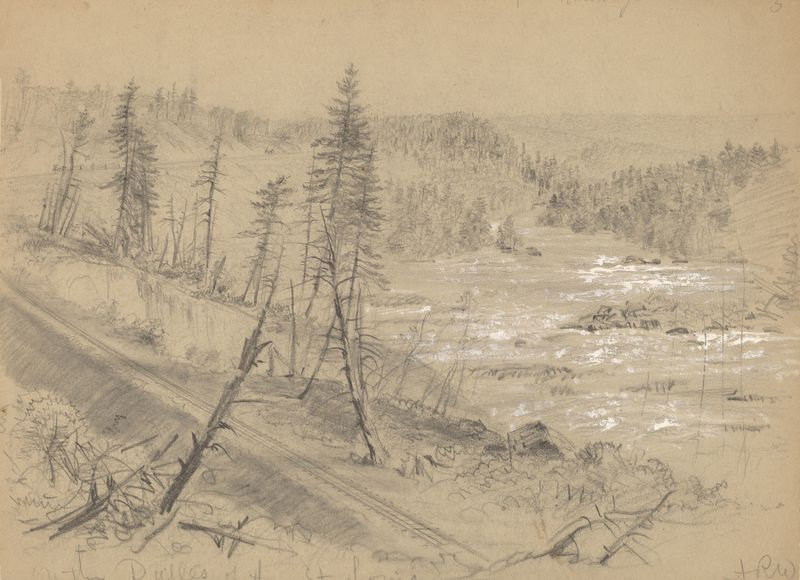
In the strokes of the early 1880s, a profound revelation unfolds within the canvas, inviting us to witness the ephemeral dance of nature and civilization intertwined. Look to the left at the rugged cliffs, their earthy tones reflected in the tranquil waters below, grounding the scene in a sense of permanence. The artist deftly employs a rich palette of greens and browns, punctuated by strokes of azure to breathe life into the flowing river. Your eyes are drawn to the cascading waterfall that spills gracefully over the rocks, embodying both movement and stillness, while the delicate interplay of light and shadow reveals the textures of the landscape with stunning clarity. Here, contrasts serve a purpose: the boldness of the cliffs juxtaposes the softness of the water’s surface, symbolizing the struggle between the indomitable force of nature and the fleeting nature of human endeavors.
The distant figures, perhaps settlers or explorers, remind us of humanity’s quest for discovery, yet their smallness against the grandeur of the landscape reveals a poignant truth — we are but fleeting moments in the vast expanse of time. The fog that envelops the horizon suggests both mystery and the inevitability of change, hinting at stories lost to history. In the early 1880s, Alfred Rudolph Waud was immersed in a rapidly evolving America, capturing landscapes that would soon be reshaped by urbanization and expansion. Working primarily as an illustrator for magazines, he found himself documenting the transformative era of westward expansion, where the majesty of nature faced the encroachment of civilization.
His works, including this evocative piece, serve as a vital visual chronicle of a nation on the cusp of a new chapter.