
Dance Of Death Bridge, Lucerne — History & Facts
What if beauty was never meant to be finished? In Dance of Death Bridge, Lucerne, the artist captures a haunting moment that feels both timeless and ephemeral, evoking a sense of innocence intertwined with life’s transience. Look to the foreground where a delicate bridge arches gracefully over a shimmering expanse of water, its reflection dancing beneath the surface. The soft hues of twilight paint the sky—pinks and purples blending seamlessly into deeper blues—while the dimming light caresses the bridge's structure, emphasizing its ethereal quality. Your eyes will be drawn to the figures crossing the bridge, small silhouettes that become metaphors for fleeting moments and the human experience, rendered in strokes that echo the soft yet deliberate brushwork that defines Goodwin’s style. The interplay of light and shadow creates a poignant contrast, suggesting an underlying theme of mortality contrasting with the celebration of life.
This duality is palpable in the way the background mountains loom majestically, representing the permanence of nature against the fragile, luminous bridge. Each element holds weight: the figures, the serene water, and the distant landscape coalesce into a narrative of innocence caught in the face of inevitable change. Created in 1909, this work reflects Goodwin's fascination with landscape and his mastery of atmospheric effects. At the time, he was living in a period marked by transition in the art world, embracing the influence of the Symbolist movement while exploring themes of spirituality and nature.
The painting exemplifies this transitional moment, encapsulating both the innocence of existence and the existential questions that linger in the human psyche.
More Artworks by Albert Goodwin
Browse all →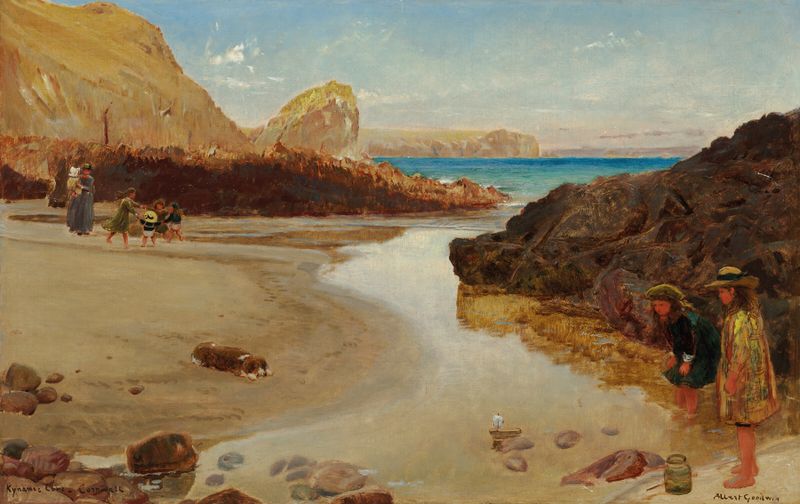
Kynance Cove, Cornwall
Albert Goodwin

Evening, St Hilda’s Abbey, Whitby, Yorkshire
Albert Goodwin

Sunset, Venice
Albert Goodwin
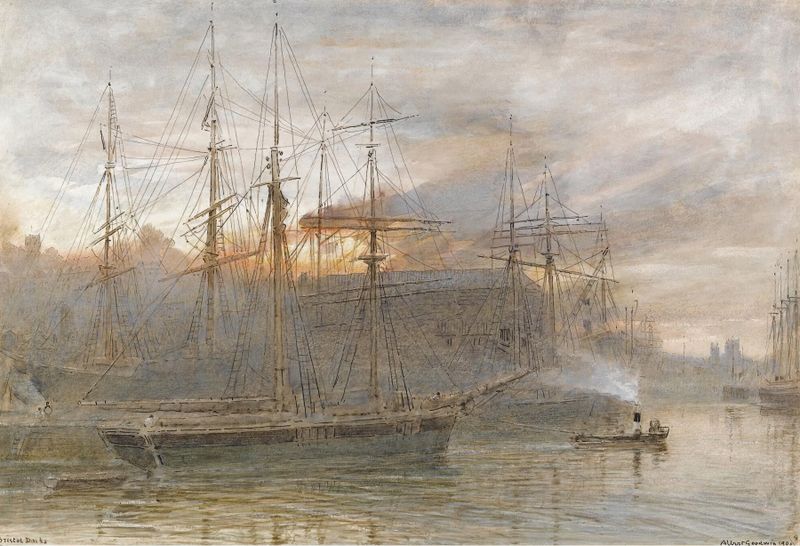
Bristol docks
Albert Goodwin

A view over Lake Lucerne
Albert Goodwin

Rockstone, Demerara, Guyana
Albert Goodwin

Autumn at Braunston, North Devon
Albert Goodwin

Night – faithful unto death
Albert Goodwin

Cabbage palms, Demerara, Guyana
Albert Goodwin

In The Moonlight, Pontresina, Engadine, Switzerland
Albert Goodwin





