
Danteplatz in Trient — History & Facts
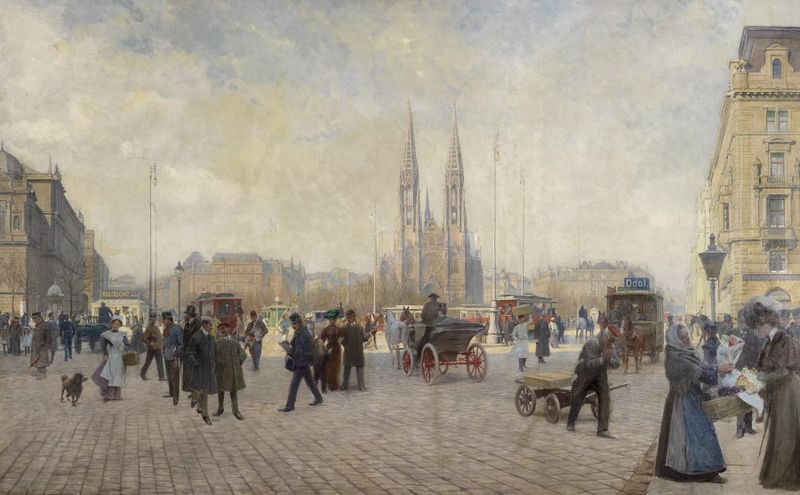
Can paint confess what words never could? In Danteplatz in Trient, vibrant hues swirl together in a dance that evokes a sense of ecstasy, capturing a moment where emotion transcends language. Look to the center where warm oranges and cool blues collide, defining the square's lively atmosphere. The towering architecture looms, painted with extraordinary detail, each brushstroke imbued with a pulse of life. Notice how the figures below mingle, their postures animated, almost as if caught in a symphony of movement, while sunlight reflects off the cobblestones, illuminating the scene with a divine glow.
This play of light and shadow draws the viewer deeper, inviting exploration of the vibrancy of everyday life. The contrast between the rigid architecture and the fluidity of the people hints at a dialogue between order and chaos. Each figure, distinct yet harmonized within the scene, tells a story of community and connection. The swirling colors suggest a celebration, perhaps hinting at a cultural or social event, urging us to feel the warmth of human interaction amidst the steadfast surroundings.
Here, ecstasy is not just an emotion but a shared experience, echoing through time and space. Created in 1903, during a period of artistic evolution in Europe, the work reflects Karl Friedrich Gsur's deep engagement with the burgeoning modernist movement. As the world around him grappled with rapid change and innovation, he found in Trient’s public square a microcosm of society — a place where history, architecture, and human emotion converge. This painting stands as a testament to the artist’s commitment to capturing not just a scene, but the essence of life itself.
More Artworks by Karl Friedrich Gsur
Browse all →
More Architecture Art
Browse all →
The statue of Liberty
Frédéric Auguste Bartholdi

View of Houses in Delft, Known as ‘The Little Street’
Johannes Vermeer

View of Houses in Delft, Known as ‘The Little Street’
Johannes Vermeer

The Cathedral in Rouen. The portal, Grey Weather
Claude Monet

The yellow house
Vincent van Gogh

The Church in Auvers-sur-Oise, View from the Chevet
Vincent van Gogh