
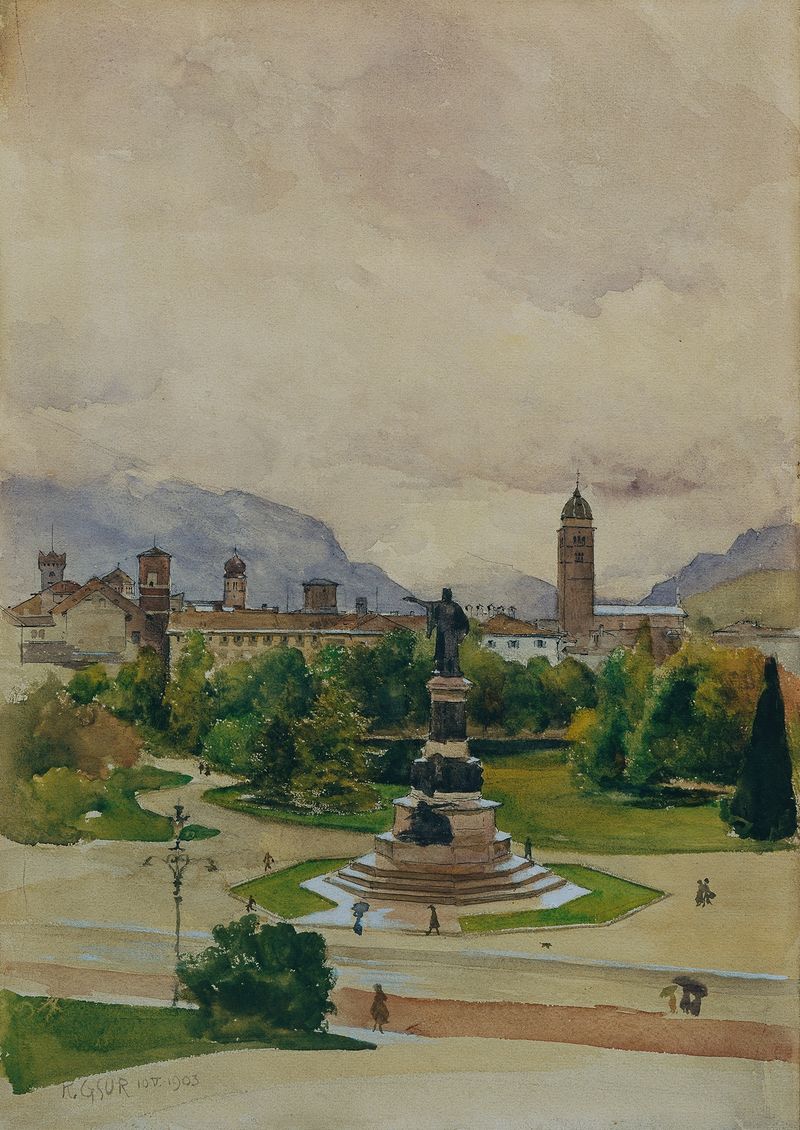
Maximiliansplatz (mit Votivkirche) — History & Facts
Who listens when art speaks of silence? In Maximiliansplatz (mit Votivkirche), the stillness reverberates with an unseen energy, beckoning viewers to engage with the tranquil yet dynamic essence of the scene. Look to the foreground, where the meticulous arrangement of pedestrians captures the pulse of everyday life. Their gestures, a mix of hurried and contemplative, create a subtle choreography against the backdrop of the Votivkirche. Notice how the light dances across the cobblestones, illuminating the varied hues of ochre and grey, while shadows stretch and recede like whispers of movement.
The artist's choice of muted colors evokes a sense of nostalgia, grounding the viewer in a moment that feels both fleeting and eternal. In this composition, contrasts emerge—between the busy figures and the stoic church, between the vibrancy of life and the serenity of architecture. The placement of the Votivkirche stands as a silent witness to the activities below, suggesting a dialogue between the sacred and the mundane. Each character, lost in their own world, reflects the unique human experience while contributing to a collective rhythm, urging us to contemplate the relationship between motion and stillness. Created in 1906, Gsur painted this work during a period of profound change in Vienna.
As an artist in the heart of a city flourishing with artistic innovation, he captured the essence of modernity emerging amidst tradition. This period saw the intersection of various movements, and Gsur's work exemplifies a balance between representation and abstraction, harmonizing the lively spirit of urban life with the stoic presence of historical architecture.
More Artworks by Karl Friedrich Gsur
Browse all →
More Architecture Art
Browse all →
The statue of Liberty
Frédéric Auguste Bartholdi

View of Houses in Delft, Known as ‘The Little Street’
Johannes Vermeer

View of Houses in Delft, Known as ‘The Little Street’
Johannes Vermeer

The Cathedral in Rouen. The portal, Grey Weather
Claude Monet

The yellow house
Vincent van Gogh

The Church in Auvers-sur-Oise, View from the Chevet
Vincent van Gogh