
Departure of Spanish Occupation Troops from Breda, October 10, 1637 — History & Facts
Could beauty survive in a century of chaos? This question lingers in the air as we gaze upon the poignant imagery crafted by a master in the turbulent era of the 17th century. In a time defined by conflict and upheaval, art becomes a vessel for both reflection and aspiration, inviting us to explore the depths of human experience amidst desolation. Look to the left at the soldiers, their uniforms reflecting the muted tones of desperation as they prepare to depart. Notice how the thick, dark clouds loom overhead, casting an ominous shadow that contrasts sharply with the warm, golden light illuminating the figures in the foreground.
The careful arrangement of troops, horses, and carts creates a sense of organized chaos, while the stark emptiness of the scene speaks volumes about the weight of loss and the burden of memory. Amidst the departure, the tension between movement and stillness is palpable. The empty space left behind by departing troops symbolizes not only a physical void but also the emotional emptiness felt by the townspeople, who are mere shadows in the background, witnesses to a history being rewritten. Each brushstroke captures the delicate balance of anticipation and melancholy, hinting at the lingering impact of the occupation on their collective psyche. Created between 1647 and 1683, this work reflects Hendrick de Meijer's engagement with historical narratives during a time of shifting power dynamics in Europe.
As the Spanish occupation receded, the artist sought to immortalize the momentous departure, encapsulating a significant turning point in Dutch history. Amidst the evolving art scene, de Meijer's meticulous attention to detail reveals a desire to document both the visual and emotional landscape of the era, bridging the gap between beauty and the chaos that surrounded him.
More Artworks by Hendrick de Meijer
Browse all →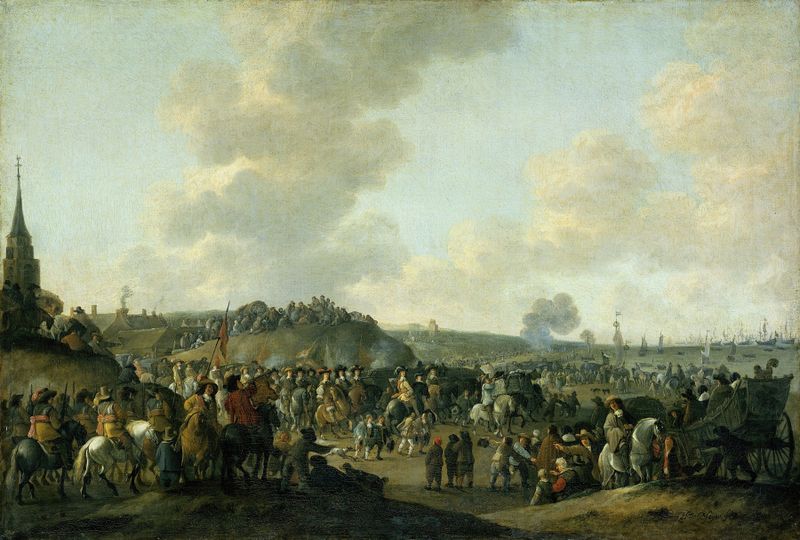

More Historical Art
Browse all →
The Night Watch Militia Company of District II under the Command of Captain Frans Banninck Cocq
Rembrandt van Rijn

Lincoln Memorial
Henry Bacon

The Third of May 1808
Francisco de Goya

Isaac and Rebecca, Known as ‘The Jewish Bride’
Rembrandt van Rijn

The Charge of the Mamelukes (1814)
Francisco de Goya

De vier ruiters van de apocalyps
Albrecht Dürer