Design for Love’s Labour’s Lost — History & Facts
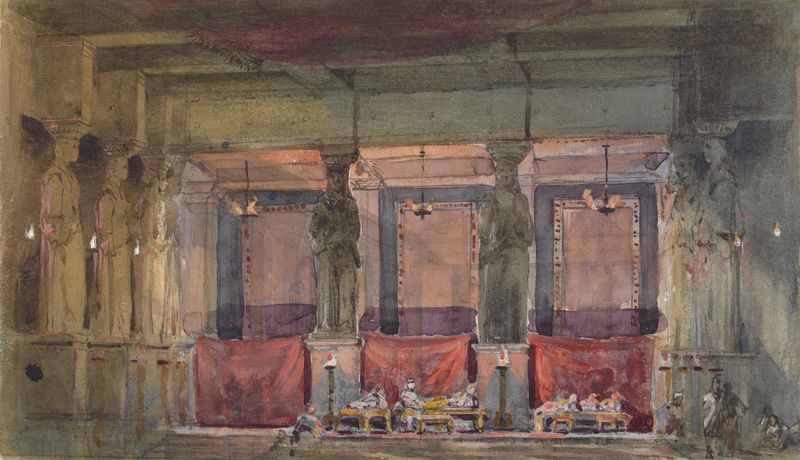
Could a single brushstroke hold eternity? In the delicate interplay of color and form, Thomas Grieve invites us to explore the boundless depth of human emotion and creative ambition through Design for Love’s Labour’s Lost. Focus first on the vibrant swirl of hues that dance across the canvas, where reds and blues collide, creating a dynamic tension that evokes both passion and conflict. Your eyes will be drawn to the intricate details of the figures, their delicate lines suggesting movement and emotion, which is masterfully accented by the light that spills across the scene, illuminating the twists of their garments. The composition, with its deliberate asymmetry, whispers of balance and imbalance, drawing us into the heart of each character's story. Hidden within the lively strokes are profound contrasts: joy tinged with melancholy, hope shadowed by doubt.
The figures seem to grasp at the intangible, representing love’s fleeting nature and the struggles inherent in artistic creation. Each brushstroke becomes a testament to the artist's personal resolve, a reflection of societal upheaval and the yearning for connection that permeates the piece. In this way, the painting captures a revolution not only of form but also of meaning, where every detail resonates with the complexity of human relationships. In 1839, Grieve worked in a burgeoning artistic environment, influenced by the Romantic movement and its emphasis on emotional expression.
This period was marked by a quest for authenticity in art, as society grappled with rapid change and the advent of new ideas. Grieve, in many ways, positioned himself at the intersection of tradition and modernity, using Design for Love’s Labour’s Lost to navigate the evolving landscape of love and artistry.