Emperor Jahangir Embraces Shah Abbas — History & Facts
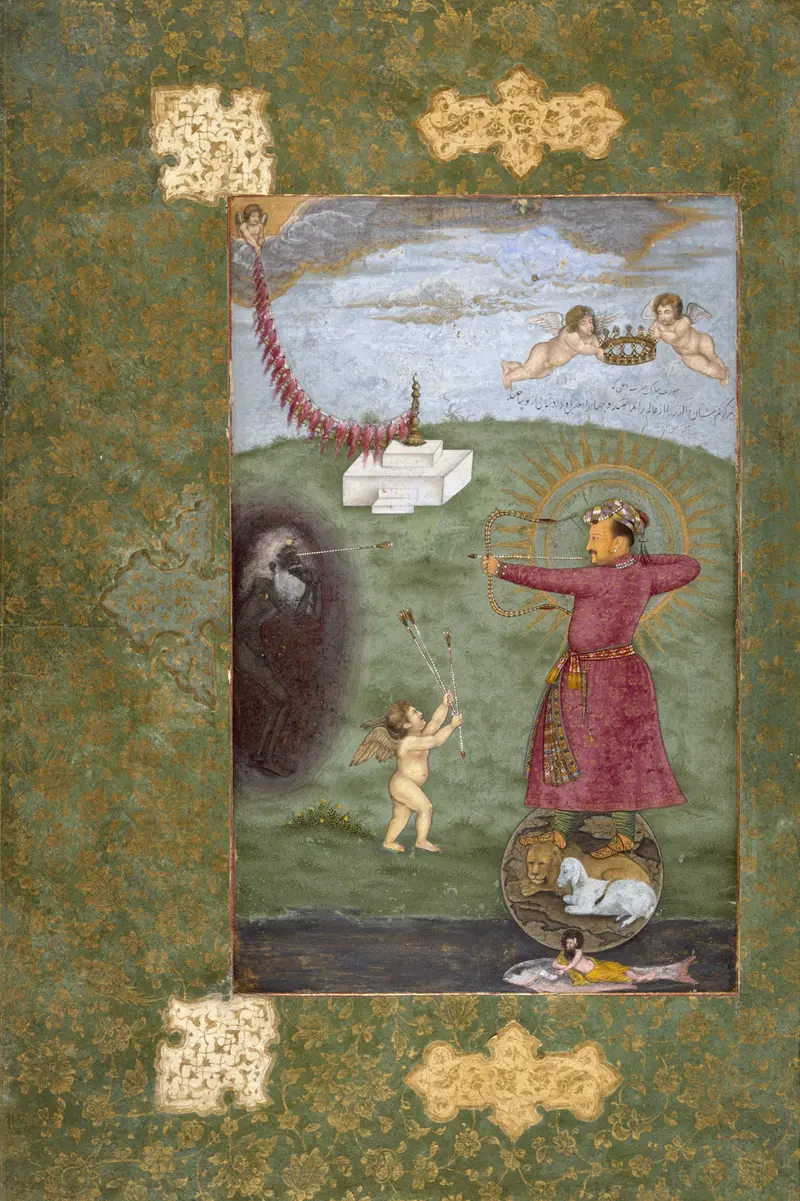
What first seizes the eye in Emperor Jahangir Embraces Shah Abbas is the golden sun, a radiant disc that seems to fuse the two rulers at its center, as if their embrace is the axis on which the world turns. The artist has staged this meeting not as a mere diplomatic gesture, but as a cosmic event: their arms entwined, their faces pressed close, the two men stand atop a map of the earth, watched over by cherubic angels. Below them, a lamb and a lion lie together in improbable peace, a visual metaphor for harmony between rivals.
Every detail is charged with meaning—the delicate hands, the careful placement of feet, the way Jahangir’s head tilts protectively over Shah Abbas, suggesting both intimacy and dominance. This painting belongs to the world of early seventeenth-century Mughal India, a court where art was a language of power, diplomacy, and aspiration. Miniatures like this were not just records but arguments, crafted to persuade and impress, often destined for albums shown only to the closest confidants of the emperor. Circa 1618, when this work was created, the Mughal and Safavid empires were both at their height, their rulers keenly aware of the theatre of sovereignty.
The lush floral borders, teeming with birds and blossoms, are typical of Mughal taste at its most refined, while the blending of Persianate and Indian elements speaks to the cosmopolitan ambitions of the court. History has kept few traces of the journey of this particular page, but its survival lets us glimpse a world where politics and art were inseparable—and invites us to read every gesture as a statement of intent.