
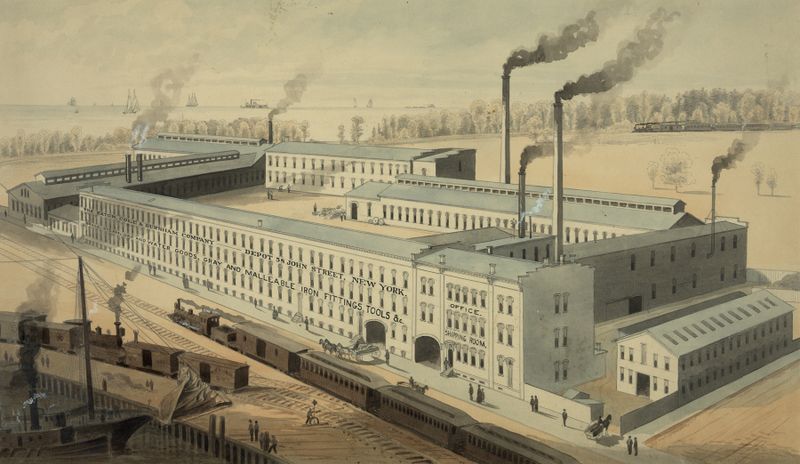
Factories of the Wheeler & Wilson M’F’G. Co., Bridgeport, Conn. — History & Facts
Can beauty exist without sorrow? The stillness of the factories, their silent machinery, invites contemplation on the paradox of industry and the human spirit. Look closely at the left side of the canvas where the imposing silhouette of the factory rises against the horizon. The play of light and shadow reveals the intricate details of its architecture, with stark lines and a muted palette that evoke a sense of solemnity. Notice how the soft, warm hues of the setting sun illuminate the scene, contrasting with the cold steel of the buildings, emphasizing the tension between nature and human creation. In this work, the artist captures not just an industrial landscape, but the quiet ache of progress.
The juxtaposition of the vibrant sky with the rigid structures beneath suggests a yearning for freedom amidst confinement. Each element—the billowing smoke from the chimneys, the orderly arrangement of the factory buildings—echoes the relentless march of time, imparting a sense of inevitability and the quiet despair that often accompanies hard labor. William Arnold Porter painted this piece in 1881 while living in Connecticut, a time when industrialization was rapidly transforming the American landscape. The rise of factories marked a pivotal moment in history, as communities flourished around the machinery of production.
This period was not only pivotal for economic change but also a moment of reflection on the impact of such progress on the human experience, a theme that resonates through Porter's work.
More Artworks by William Arnold Porter
Browse all →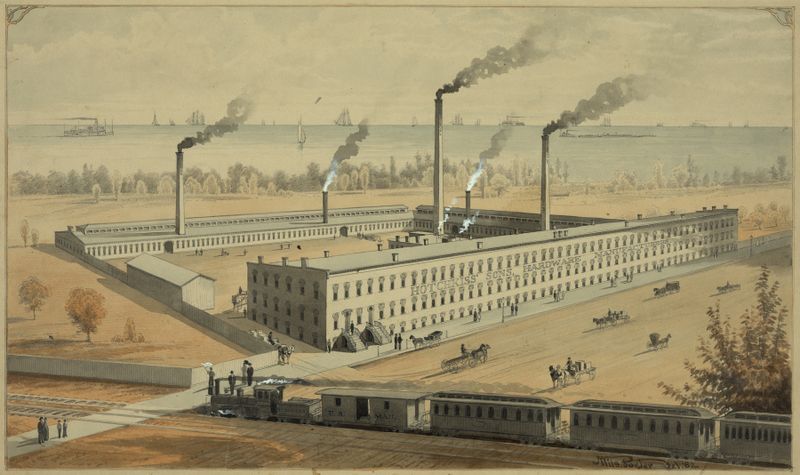
More Architecture Art
Browse all →
The statue of Liberty
Frédéric Auguste Bartholdi

View of Houses in Delft, Known as ‘The Little Street’
Johannes Vermeer

View of Houses in Delft, Known as ‘The Little Street’
Johannes Vermeer

The Cathedral in Rouen. The portal, Grey Weather
Claude Monet

The yellow house
Vincent van Gogh

The Church in Auvers-sur-Oise, View from the Chevet
Vincent van Gogh