
Felsküste im Mondschein — History & Facts
In the quiet embrace of twilight, where reflections shimmer on the surface of still waters, melancholy invites us to ponder our deepest yearnings. Focus on the serene interplay between the moon and the landscape in Felsküste im Mondschein. The silvery glow gently caresses the jagged cliffs, casting elongated shadows that dance across the canvas. Dark, muted blues and soft grays dominate the palette, evoking a sense of solitude, while a faint hint of luminescence suggests an ethereal presence just beyond our reach.
The composition leads the eye from the rocky shore up toward the horizon, where the moon hangs suspended in a deep velvet sky, imparting a haunting tranquility. Yet, within this beauty lies an undercurrent of sorrow. The rugged cliffs, though majestic, evoke a sense of isolation, reflecting the emotional struggle of longing for connection. Notice how the moonlight creates a stark contrast between light and shadow, whispering of dreams unfulfilled and hope fading into the night.
The stillness of the water mirrors our own introspections, revealing that even in beauty, there is a profound sense of loss and yearning. In 1830, at a time when Romanticism was blossoming, the artist navigated the complexities of nature and emotion in his work. Living in a period marked by societal upheaval and personal challenges, he sought to capture the essence of the sublime in landscapes. This painting reflects the emotional turmoil of the era, as well as the artist's own internal conflicts, merging artistic exploration with the broader movements of his time in an evocative dialogue between nature and the human spirit.
More Artworks by Johann Nepomuk Schödlberger
Browse all →
Landschaft mit Wasserfall und Hirten
Johann Nepomuk Schödlberger
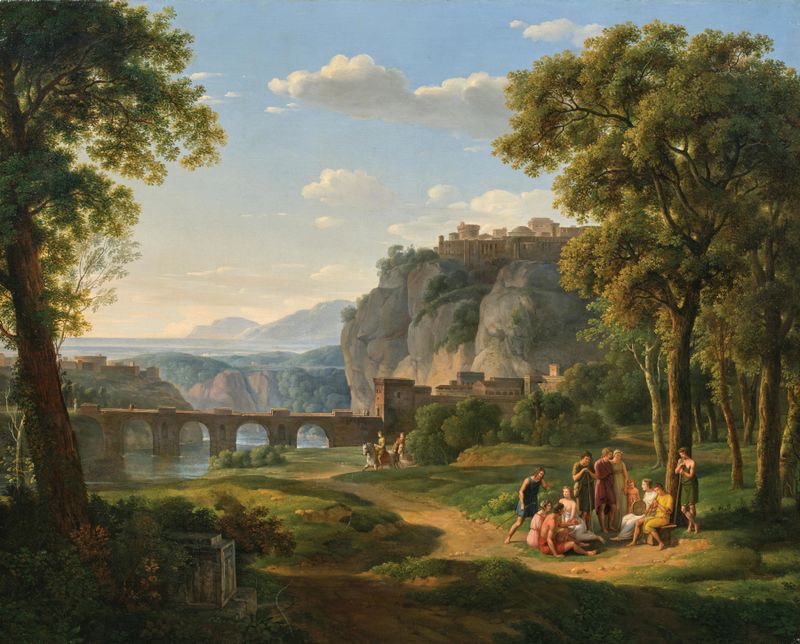
An Arcadian Landscape with a Bridge
Johann Nepomuk Schödlberger

Der Traunfall bei Gmunden
Johann Nepomuk Schödlberger

A Harbour Landscape with Temples
Johann Nepomuk Schödlberger

Villa Gregoriana, Tivoli
Johann Nepomuk Schödlberger

A View of a Majestic Park
Johann Nepomuk Schödlberger





