
Villa Gregoriana, Tivoli — History & Facts
In the quiet chambers of our hearts, there exists a yearning for places that linger just beyond our reach. Look to the left, where the cascading waterfall breathes life into the composition, its shimmering water capturing the sun's rays. Notice how the artist employs a palette of soft greens and earthy browns to evoke the lushness of the surrounding landscape, while the delicate brushstrokes create a sense of movement. The gentle arch of the trees frames the villa in the background, drawing our eyes to the architectural elegance that seems to blend seamlessly with nature. Amidst the verdant backdrop lies an emotional tension, a contrast between the tranquility of the scene and the underlying sense of nostalgia it evokes.
The villa stands as a symbol of human ambition, yet it is enveloped by wild foliage, suggesting a perpetual struggle between civilization and nature. The interplay of light and shadow across the canvas accentuates this longing, as if inviting the viewer to ponder the stories hidden in those ancient walls. In 1843, Johann Nepomuk Schödlberger sought to capture the beauty of Villa Gregoriana in Tivoli, a site revered for its romantic landscapes. At this time, artists were increasingly drawn to the sublime aspects of nature as industrialization began to reshape the world around them.
Schödlberger’s work reflects both the personal and collective yearning for the past, a search for solace in the embrace of nature amidst an evolving society.
More Artworks by Johann Nepomuk Schödlberger
Browse all →
Landschaft mit Wasserfall und Hirten
Johann Nepomuk Schödlberger
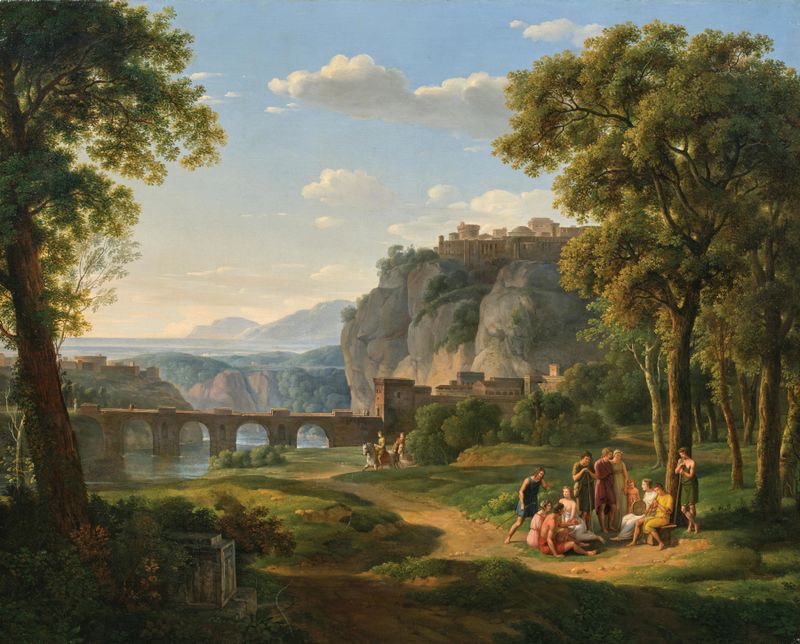
An Arcadian Landscape with a Bridge
Johann Nepomuk Schödlberger

Der Traunfall bei Gmunden
Johann Nepomuk Schödlberger

A Harbour Landscape with Temples
Johann Nepomuk Schödlberger

A View of a Majestic Park
Johann Nepomuk Schödlberger

Felsküste im Mondschein
Johann Nepomuk Schödlberger





