
Fontaine, Meknès — History & Facts
Can paint confess what words never could? In Fontaine, Meknès, the canvas becomes a conduit for whispers of divinity, a realm where the sacred and the everyday entwine. Look to the center of the piece where the fountain emerges, an intricate design of swirling tiles reflecting the sun’s glow. The terracotta hues contrast with the deep greens and blues of the surrounding foliage, guiding your eye to the intricate patterns that seem to pulse with life. Notice how the light dances upon the surface of the water, creating a serene yet vibrant atmosphere; the artist’s mastery of color imbues the scene with a sense of peace, while the flowing lines suggest an underlying movement, a gentle reminder of nature’s rhythms. Delve deeper into the details—the way the water seems to laugh as it spills from the fountain’s spout, or the playful shadows that stretch across the tiled floor.
Each element resonates with a sense of time suspended, and the whispers of history echo through the colors. This moment captures not just the beauty of a Moroccan courtyard but the essence of existence itself, portraying a world where the divine manifests in the mundane through the art of observation. Alexandre Roubtzoff painted Fontaine, Meknès in 1921, during a period when he was immersed in the rich cultural tapestry of Morocco. This was a time of artistic exploration, marked by the allure of exoticism and the intersection of Western art and Eastern traditions.
Living in Paris yet captivated by the landscapes and architecture of North Africa, Roubtzoff sought to bridge these worlds, creating works that reflect both his travels and the broader shifts within the art world of the early 20th century.
More Artworks by Alexandre Roubtzoff
Browse all →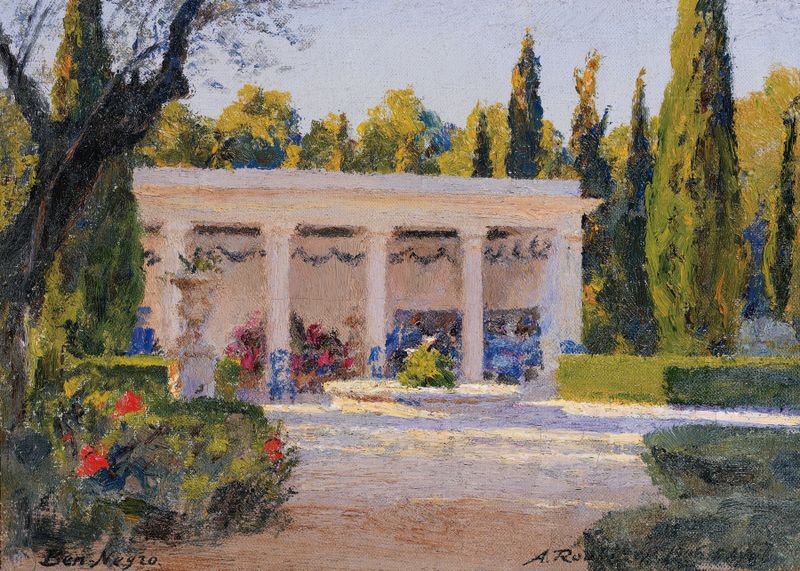

More Architecture Art
Browse all →
The statue of Liberty
Frédéric Auguste Bartholdi

View of Houses in Delft, Known as ‘The Little Street’
Johannes Vermeer

View of Houses in Delft, Known as ‘The Little Street’
Johannes Vermeer

The Cathedral in Rouen. The portal, Grey Weather
Claude Monet

The yellow house
Vincent van Gogh

The Church in Auvers-sur-Oise, View from the Chevet
Vincent van Gogh