Forest — History & Facts
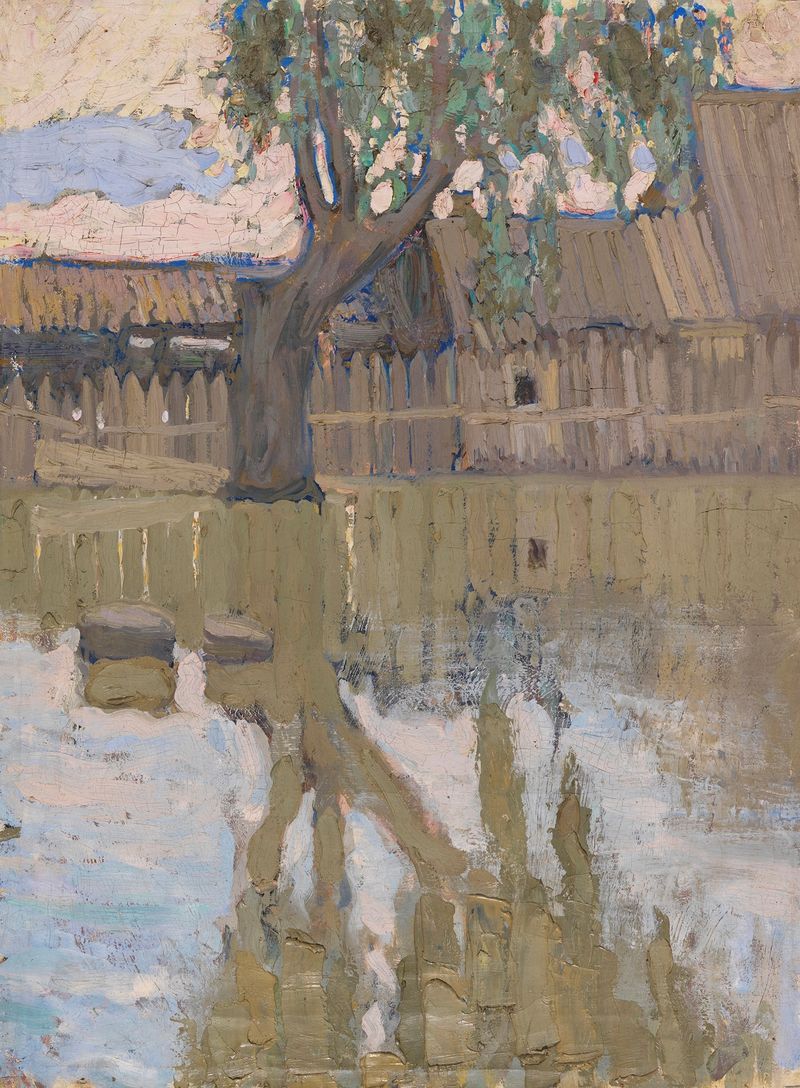
Where does light end, and longing begin? In the ethereal realm of dreams, boundaries dissolve, as if the very essence of nature beckons us to wander deeper. Focus on the luminous strokes of emerald and gold that swirl across the canvas, inviting your gaze to explore the vibrant interplay of colors. The vivid foliage, rendered with sweeping brushwork, suggests movement, as though a gentle breeze whispers through the trees. Notice how the light spills from the upper corner, illuminating patches of the underbrush—a luminous contrast to the shadowy depths lurking beyond, creating an enchanting dialogue between the known and the unknown. Here, the forest emerges not merely as a backdrop, but as a living entity, filled with the allure of the unseen.
The play of light symbolizes hope and desire, while the darker areas hint at mystery and the subconscious. This tension mirrors the artist's own journey—between clarity and ambiguity, reality and fantasy—allowing viewers to traverse their own emotional landscapes within the dreamlike foliage. Vladimir Baranov-Rossiné painted this piece between 1908 and 1910 while living in Paris, a city ripe with artistic innovation and the fervor of modernism. At this time, he was immersed in the vibrant avant-garde scene, influenced by both Russian traditions and Western European movements.
His exploration of abstraction and color dynamics reflected the broader shifts in the art world, as he sought to capture not just the physical beauty of nature, but its profound emotional resonance.