Frauengang — History & Facts
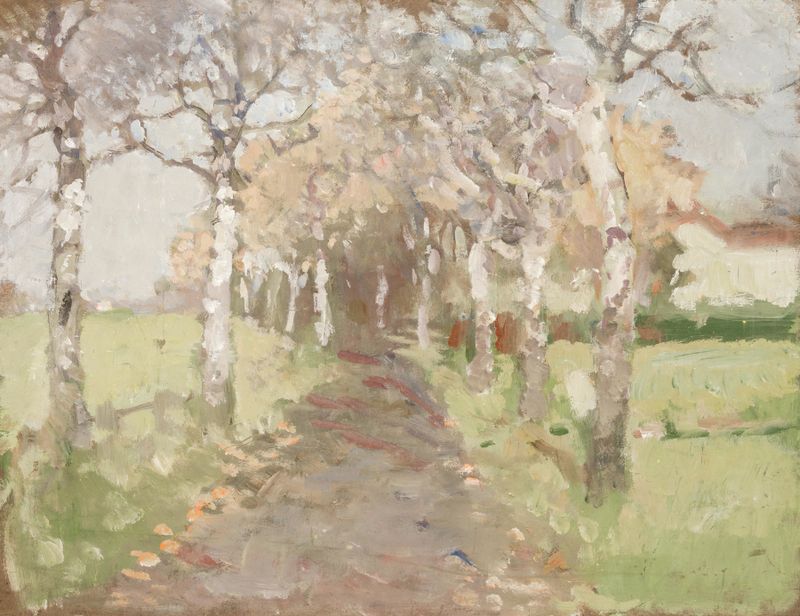
In its stillness, it holds echoes of grief, beckoning the viewer to confront the weight of absence and longing. Look to the center of the composition, where a solitary figure stands poised amid a landscape that teeters between vitality and melancholy. The muted palette of blues and greens envelops her, while soft, diffused light dances across the surface, casting gentle shadows that hint at the complexities of her internal world. Notice how the elongated forms of trees stretch upward, their silhouettes mimicking her own, suggesting a bond between the woman and the natural elements surrounding her. The interplay of light and shadow creates an emotional tension, revealing the duality of her presence — both anchored to the earth and suspended in the air of sorrow.
The slight tilt of her head and the gentle clasp of her hands reflect a moment of contemplation, suggesting a past filled with memories that weigh heavily upon her. Each brushstroke resonates with the duality of grief and hope, as the landscape breathes life even in its somber hues. During this period, the artist worked between 1935 and 1940, a time marked by both personal introspection and the broader shadows of global unrest. Wennerberg, living in Sweden, navigated a world grappling with the approaching turmoil of World War II while also exploring themes of nature and human emotion in his art.
This work encapsulates his search for meaning amid uncertainty, revealing the deeply human experience of coping with loss.