
Front View of Buitenzorg Palace during the Earthquake of 10 October 1834 — History & Facts
When did color learn to lie? In the wake of calamity, the vibrant hues of nature often mask the chaos beneath, inviting dreams while concealing truths. Look to the center where the majestic structure of Buitenzorg Palace rises against a backdrop of ominous skies, a gleam of hope amidst encroaching disaster. Notice the intricate details of the palace’s façade — the fine brushwork captures both architectural elegance and impending doom. The palette is rich, yet the stark contrast between the deep greens of the foliage and the stormy blues suggests a brewing tension that feels palpable.
The billowing clouds above appear almost alive, writhing with energy that hints at the earthquake’s approach, while vibrant yellows in the foreground tease the eye with a deceptive calm. Delve deeper into the scene, and you’ll find emotional layers interwoven within the brushstrokes. The serene beauty of the palace starkly juxtaposes the violent turmoil of nature, bridging dreams and reality. One cannot ignore the figures scattered throughout; their poses depict a moment suspended in time, caught between admiration and fear.
In their stillness lies an unspoken acknowledgment of the disaster looming, drawing attention to humanity's fragile existence against nature's overwhelming forces. Willem Troost the younger painted this work between 1834 and 1836, shortly after the catastrophic earthquake that struck Java. Living in a world punctuated by political unrest and natural disasters, he aimed to capture not just the edifice of the palace but the very spirit of a time in turmoil. The choice to depict such a significant moment speaks volumes about his artistic vision, melding history with emotional resonance, and revealing the delicate balance between beauty and devastation.
More Artworks by Willem Troost the younger
Browse all →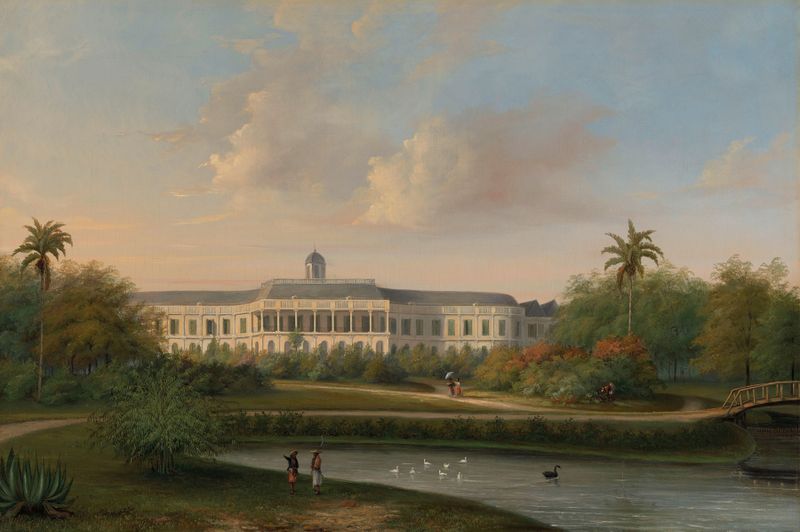
More Architecture Art
Browse all →
The statue of Liberty
Frédéric Auguste Bartholdi

View of Houses in Delft, Known as ‘The Little Street’
Johannes Vermeer

View of Houses in Delft, Known as ‘The Little Street’
Johannes Vermeer

The Cathedral in Rouen. The portal, Grey Weather
Claude Monet

The yellow house
Vincent van Gogh

The Church in Auvers-sur-Oise, View from the Chevet
Vincent van Gogh