Gebirgslandschaft bei Athen (Der ‘Areopag’) — History & Facts
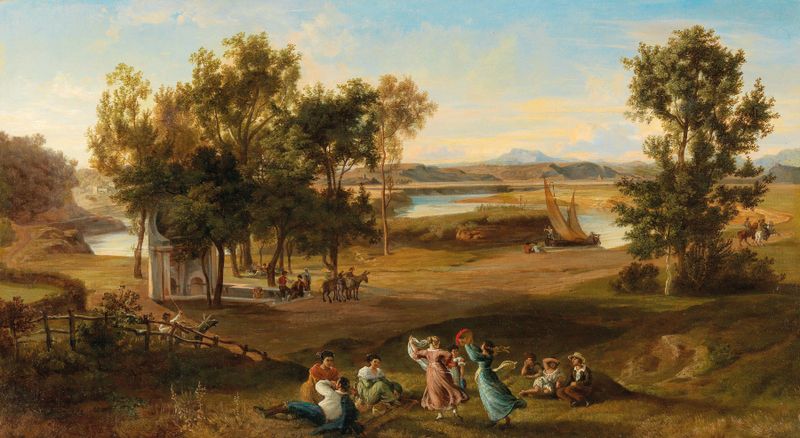
In the realm of dreams, our aspirations intertwine with the landscapes of our minds, and in this eternal landscape, one can find a reflection of self. Look to the foreground of Gebirgslandschaft bei Athen (Der ‘Areopag’), where soft undulations of earth rise gently toward the horizon. The artist masterfully employs a palette of verdant greens and muted browns, a lush depiction of the terrain that evokes a sense of tranquility. Notice how the sunlight spills over the hills, creating a delicate interplay of light and shadow that guides your gaze toward the distant mountains, almost beckoning you into their embrace. Within this serene backdrop lies a tension between the familiar and the extraordinary.
The gentle slopes suggest a peaceful existence, yet the looming presence of the mountains hints at ambitions that remain just out of reach. The sky's soft blues juxtaposed with the rich earth tones serve as a subtle reminder of the dreams that linger above our everyday lives, urging us to seek the extraordinary hidden in the mundane. In 1854, Josef Hoffmann was immersed in the vibrant artistic movements of his time, while grappling with the evolving nature of landscape painting. Working in Athens, he was inspired by the classical beauty surrounding him, reflecting a shift towards romanticism that emphasized emotional resonance over mere representation.
This piece embodies that transition, capturing not just a physical space, but an essence—a dreamscape intertwined with reality.