German Landscape (Isar Landscape) — History & Facts
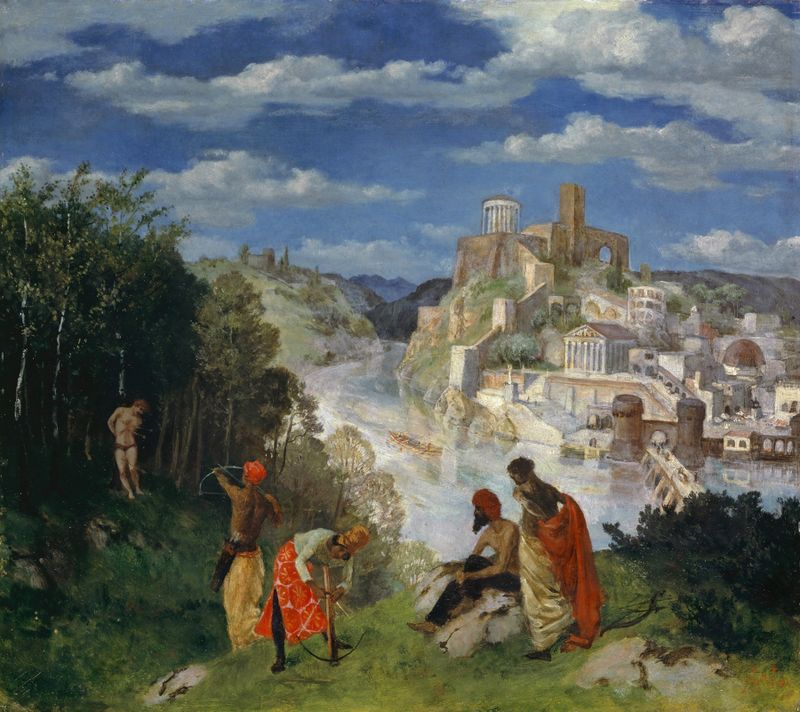
Can beauty exist without sorrow? In German Landscape (Isar Landscape), the delicate balance of innocence and melancholy invites contemplation of nature’s duality. Look to the left at the verdant hills, their lush greens contrasting sharply with the somber grays of the sky above. The subtle brushwork reveals a textured surface that vibrates with the life of the landscape, while the winding Isar River captures the light, reflecting a soft shimmer that guides the eye. Notice how the horizon line draws you into the depths of the scene, where the interplay of light and shadow creates a serene yet haunting atmosphere.
The composition is a harmonious blend of color and form, yet it hints at an underlying tension, as if nature herself holds a secret. Explore the emotional layers embedded within the tranquil beauty. The serene river suggests a flow of time, juxtaposed against the heavy clouds that loom above, signaling rain or perhaps a storm. This contrast may convey a sense of innocence about to be tested, a fleeting moment before nature’s inevitable changes.
The small figures in the landscape, dwarfed by their surroundings, evoke feelings of vulnerability, reminding us that beauty often coexists with the weight of existence itself. Created between 1900 and 1901, Albert Welti painted German Landscape during a period of transition in the art world, where traditional boundaries were beginning to blur. Living in Switzerland, Welti was influenced by the Symbolist movement, which sought to express deeper emotional truths. This was a time when artists were exploring the profound connections between humanity and the natural world, reflecting a society on the cusp of modernization and the complexities it brought.