Heuernte im Vorgebirge — History & Facts
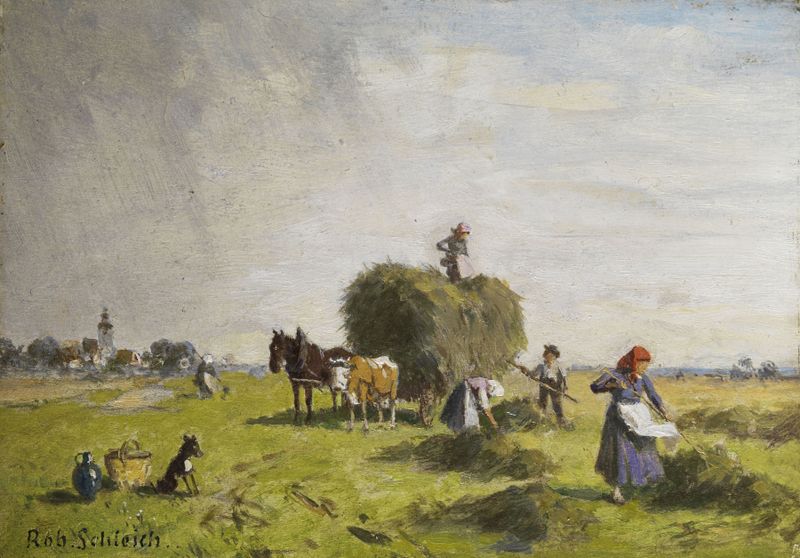
Can paint confess what words never could? In Heuernte im Vorgebirge, Robert Schleich captures the essence of labor and nature's bounty, whispering secrets of both toil and tranquility. Look closely at the vibrant fields sprawling across the canvas, where the golden hues of ripe hay contrast starkly with the cool greens of the surrounding hills. Notice how the figures, clad in earthy tones, bend and stretch, their bodies embodying the rhythm of harvest as they work with a sense of purpose. The light, dappled and warm, accentuates the textures of their clothing and the richness of the landscape, drawing the viewer into this moment of rural life. The interplay between labor and leisure emerges in the details: a distant figure pauses, reflecting the quiet gratitude found in hard work, while the lush background suggests the overwhelming beauty of nature, almost too vast to contain.
Schleich masterfully balances these elements, hinting at the inevitable changes that industrialization was beginning to impose on such pastoral scenes. Each stroke conveys a sense of nostalgia and a yearning for the simplicity of agrarian life amid the looming shadows of modernity. Painted in 1900, during a time of profound change in the art world and society at large, Schleich created this piece in Germany, a nation grappling with the tensions of urbanization and the loss of traditional ways. This work reflects a moment in which artists sought to document the familiar yet fleeting beauty of rural existence, capturing a way of life soon to be transformed by revolution.