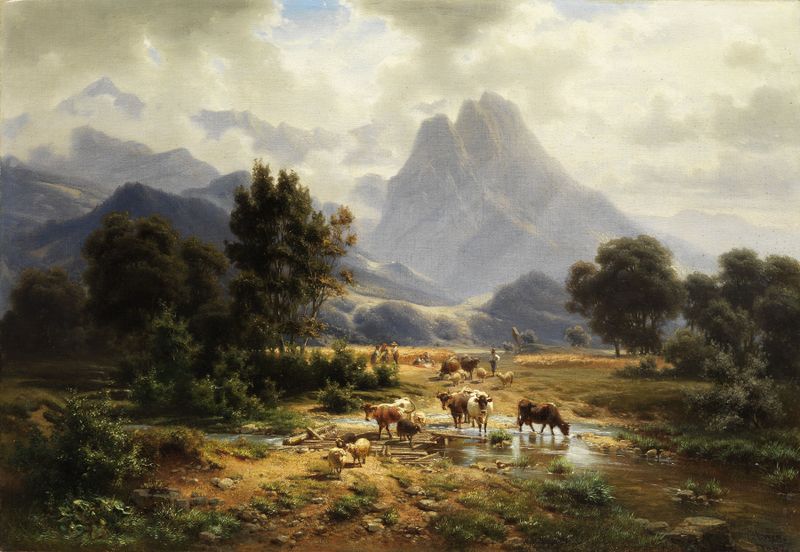
Hirtenjunge mit Vieh bei Partenkirchen mit Blick auf das Wettersteingebirge — History & Facts
In the delicate dance between struggle and aspiration, we often find fragments of hope nestled within the harshest realities of life. This duality whispers through Hirtenjunge mit Vieh bei Partenkirchen mit Blick auf das Wettersteingebirge, inviting us to delve deeper into its serene landscape. Look to the foreground of the painting where a young shepherd stands, stoic yet contemplative, surrounded by grazing animals. Notice how the warm hues of the sun bathe the scene in a golden light, illuminating the soft textures of the sheep's wool and the ruggedness of the boy's attire.
The backdrop, dominated by the majestic Wetterstein mountains, looms with both grandeur and isolation, hinting at a world beyond the immediate tranquility and evoking a sense of longing. Upon closer inspection, the interplay of light and shadow reveals the shepherd's subtle expression—a mix of determination and weariness. The gentle curve of the hills contrasts sharply with the jagged peaks above, embodying the struggle between the simplicity of pastoral life and the daunting challenges of nature. This tension speaks to a universal narrative of finding hope in adversity, each element echoing the resilience inherent in the human spirit. Heinrich Höfer painted this piece in 1862 while living in Germany, a time when Romanticism was influencing art across Europe.
Amidst a burgeoning fascination with nature and rural life, he sought to encapsulate not only the picturesque beauty of the Alps but also the deeper emotional currents that define existence. His work reflects a personal and artistic journey, merging the idyllic with the poignant, which resonated deeply in the context of the era.