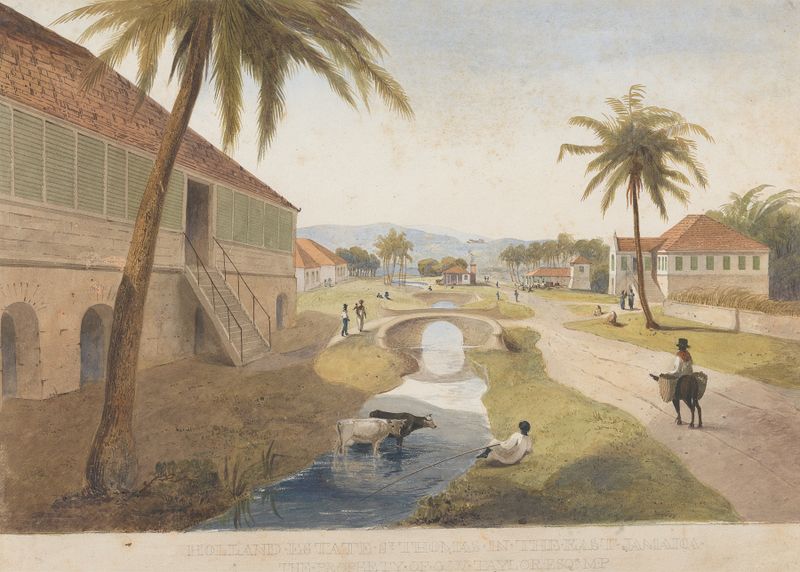
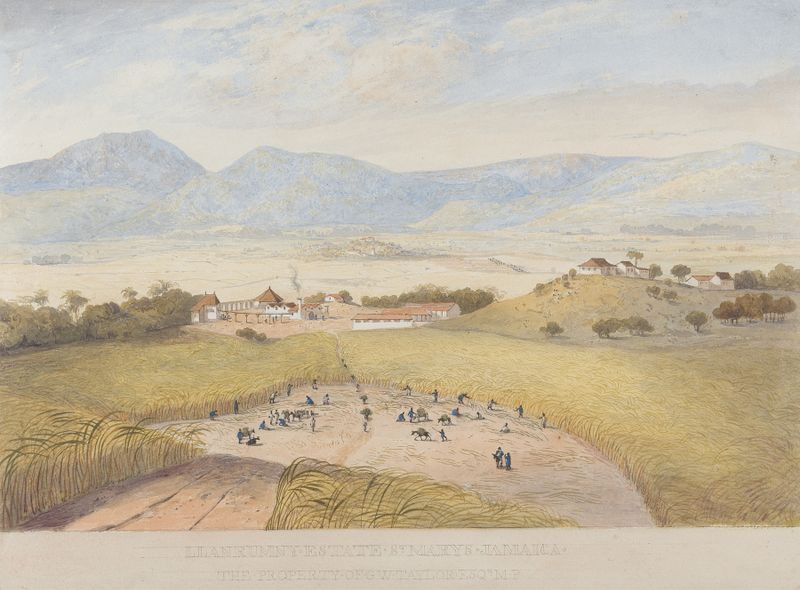
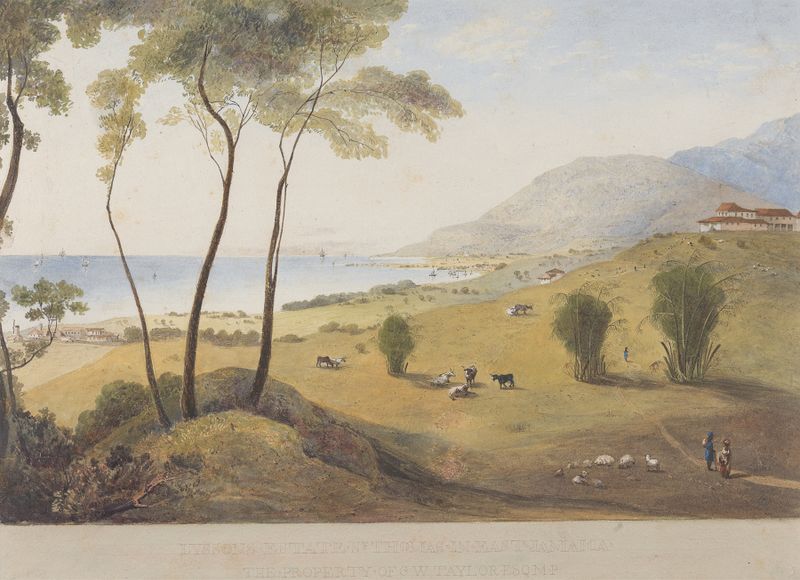
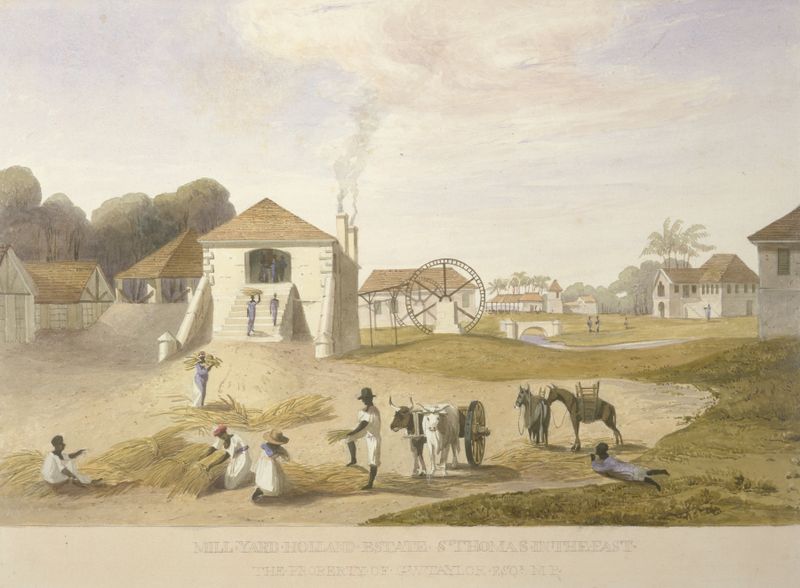
Holland Estate, St. Thomas in the East, View from the Change of Air House — History & Facts
This paradox is beautifully encapsulated in the lush landscape of a Caribbean estate, where vibrant colors mask the weight of history and memory. Look to the lower right, where the dense, green foliage spills over the edge of the estate, inviting the eye into the composition. The rolling hills of St. Thomas unfurl in a cascade of emerald, punctuated by the warm, golden hues of the sun that filters through the clouds above.
Notice how the interplay of light and shadow gives depth to the scene, highlighting the architecture that stands resolute amidst nature’s overwhelming embrace. The artist skillfully employs a palette that blends the rich blues of the sky with the deep greens of the landscape, creating a sense of harmony that is both inviting and haunting. Yet, beneath this serene façade lies a tension steeped in history. The estate, a symbol of colonial prosperity, evokes the duality of beauty and exploitation — a reminder of the enslaved lives that toiled in its shadows.
The tranquil waters at the horizon mirror this dichotomy, reflecting both the idyllic surroundings and the turbulent past. Each brushstroke seems to whisper stories of joy and sorrow, of memory etched into the very soil upon which the estate stands. During the years 1820 to 1821, the artist created this work while experiencing the vibrant cultural exchanges of the Caribbean, after establishing himself in England. The period was marked by evolving perceptions of colonial landscapes and a growing awareness of the moral implications surrounding them.
In this context, the execution of Holland Estate serves not only as a captured moment of beauty but as a crucial commentary on the complexities of memory and legacy in a changing world.