Horse in the Mountains — History & Facts
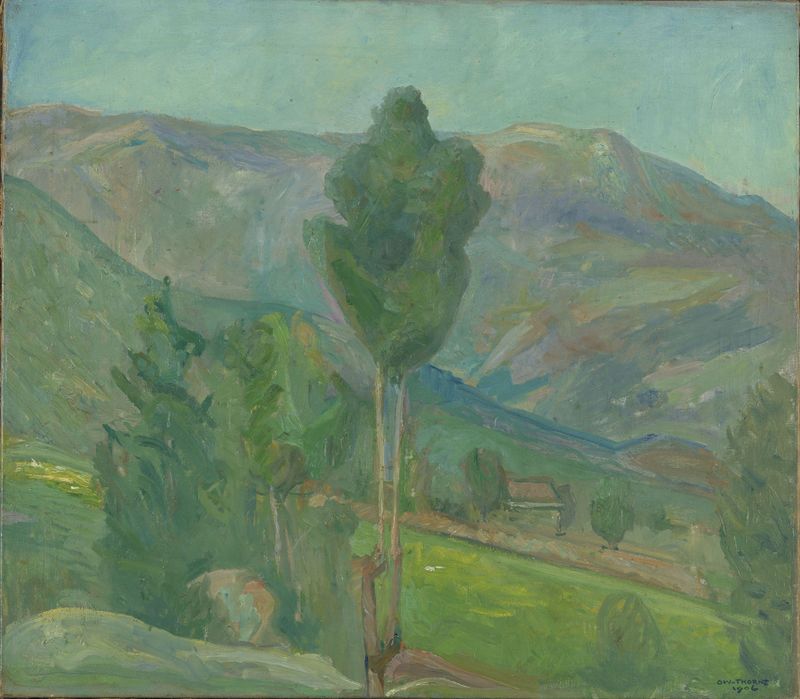
Can paint confess what words never could? In Horse in the Mountains, nostalgia flows like a gentle breeze, inviting us to explore the unspoken memories held within its vibrant strokes. Look to the center of the canvas where the majestic horse stands, poised against a backdrop of undulating mountains. The artist employs a rich palette of greens and browns, with sunlight dappling the horse’s glossy coat, illuminating its strength and serenity. Notice how the mountains rise abruptly in the background, their jagged peaks softened by the mist that clings to their bases, creating a sense of distance and depth that draws the eye upward and outward. Here, the horse symbolizes freedom and connection to nature, embodying a harmony that contrasts with the looming, rugged mountains that surround it.
The delicate brushwork suggests a fleeting moment, perhaps a sigh of longing or an echo of the past, inviting the viewer to ponder the relationship between the horse, its environment, and the passage of time. The balance between light and shadow encapsulates the tension between solitude and companionship, reminding us of the quiet moments of reflection in our own lives. Oluf Wold-Torne created Horse in the Mountains in 1902, a period marked by his exploration of Norwegian landscapes and a growing appreciation for naturalism in art. Residing in Norway, he was influenced by both the romantic appreciation of nature and the technical mastery of his contemporaries, leading to a profound expression of nostalgia in his works.
This painting reflects not only his personal vision but also the broader context of an artistic movement that sought to articulate the emotional resonance of the natural world.