Indians Stalking Elk — History & Facts
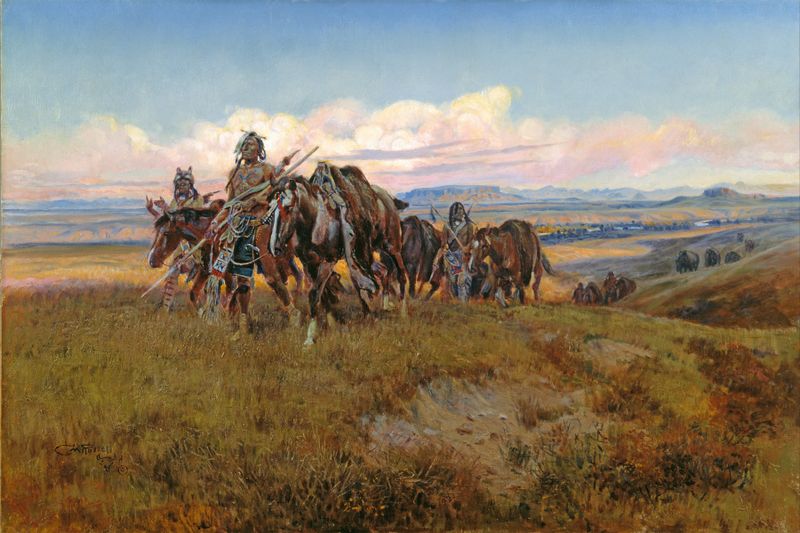
Could a single brushstroke hold eternity? In Indians Stalking Elk, the artist captures not just a moment, but the essence of life’s intricate dance with nature, where every shadow tells a story. Look to the left at the graceful arch of the Indian horseman, poised like a taut bowstring against the sprawling landscape. Notice how the muted earth tones blend seamlessly into the soft silhouettes of dawn. The gentle play of light across the figures accentuates their connection to the land; it breathes life into the canvas and invites you to breathe along with it.
Each stroke feels deliberate, as if the artist wished to convey every nuance of both strength and fragility inherent in this hunting scene. Yet, beneath the surface lies a contrast between the hunters and their majestic prey. The elk, noble and powerful, almost appears oblivious to the danger encroaching upon it. This tension captures not only the pursuit of life but the ever-present shadow of mortality that looms over us all.
The way the brushwork separates the hunters from the wilderness evokes a deeper commentary on the relationship between man and nature, suggesting that every chase carries the weight of reverence and respect. In 1897, Charles Marion Russell was immersed in the American West, capturing its raw beauty and untamed spirit in his art. At this time, the artist was establishing his legacy as a storyteller of the frontier, drawing inspiration from the landscapes and peoples he revered. The socio-political climate of the era—marked by the westward expansion and its complex interactions with Native American cultures—influenced his perspective, prompting him to document a world on the brink of change.