Italian Landscape — History & Facts
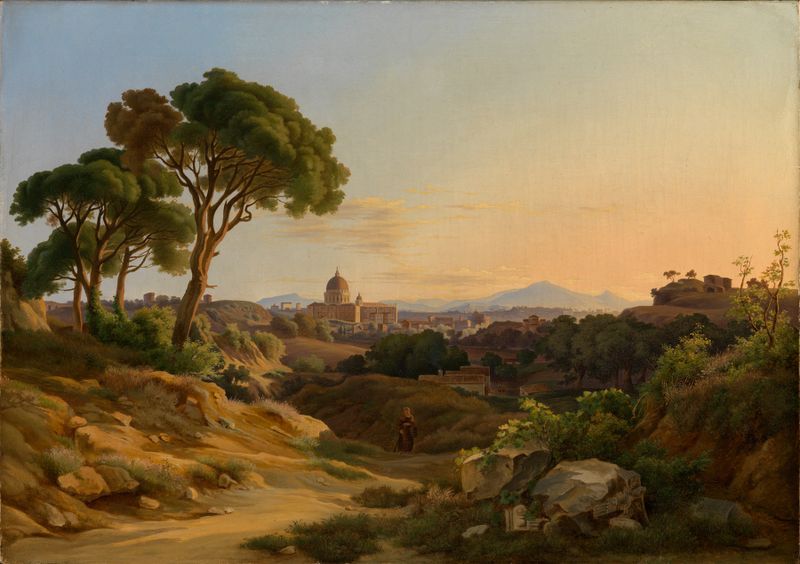
In the quiet expanse of an Italian landscape, the viewer encounters a profound void — a serene stillness that invites introspection and contemplation. Focus on the horizon, where rolling hills meet a soft, azure sky. The delicate interplay of greens and browns reveals a rich tapestry of earth and foliage, while the gentle light illuminating the scene casts a warm glow, drawing attention to the undulating forms. Notice how the composition leads the eye from the foreground, dotted with ancient trees, to the distant mountains that seem to whisper secrets of time. Hidden within the tranquil beauty lies a contrast between the vibrancy of nature and the vast emptiness that surrounds it.
The distant mountains, though majestic, evoke a sense of solitude, reminding us of the ever-present void in our lives. Each brushstroke carries the weight of contemplation, as Köbel captures not just the scenery, but also the emotional tension between presence and absence, inviting the viewer to reflect on their own experiences of isolation and connection. In 1843, Georg Köbel painted this landscape during a time marked by the burgeoning Romantic movement in Europe, which sought to emphasize emotion and nature. At this time, Köbel was refining his technique while exploring themes of tranquility and the sublime.
Living in Germany but influenced by his travels, he was part of a wider cultural shift that began to appreciate the Italian landscape as a symbol of ideal beauty and spiritual exploration.