Javanese Jungle — History & Facts
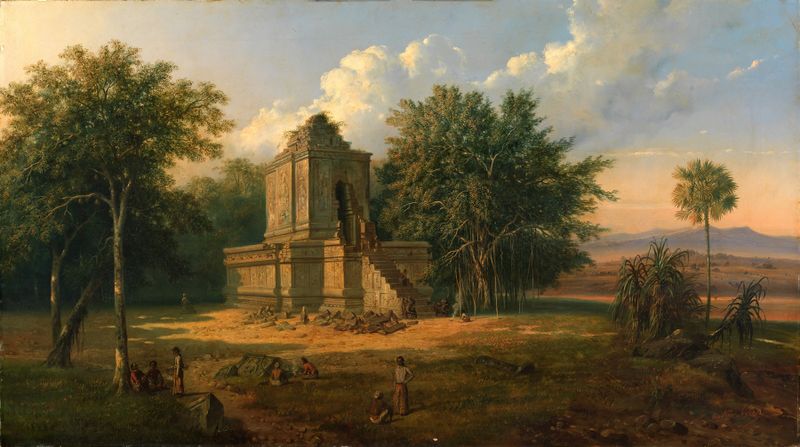
Is this a mirror — or a memory? The vivid greens and earthy browns of the Javanese jungle beckon the viewer to step beyond the canvas, inviting a reflection on the beauty and complexity of nature. Look to the lush foliage sprawling across the canvas, where deep emerald leaves cradle the gentle play of sunlight filtering through. Notice how the artist employs a rich palette of colors to create depth, with layers of paint giving an almost tactile quality to the textures. The soft contrasts between shadow and light draw the eye to the center, where a lone figure stands in quiet harmony with the vibrant surroundings. In this artwork, the interplay of color evokes a sense of tranquility, yet carries an undercurrent of tension.
The serene expression of the figure belies the latent energy of the jungle, suggesting an intimate connection to nature that transcends mere observation. The dense vegetation symbolizes both beauty and the unknown, prompting the viewer to ponder the boundaries between civilization and the wild. Raden Saleh painted Javanese Jungle in 1860 during his time in the Netherlands, where he was often hailed as one of the first Indonesian artists to gain recognition in Europe. The work reflects his fascination with his homeland while navigating the complexities of colonial dynamics and cultural identity.
This period was marked by his exploration of themes that resonated with both Eastern and Western audiences, positioning him as a pivotal figure in the art world of his era.