Kilauea at Night — History & Facts
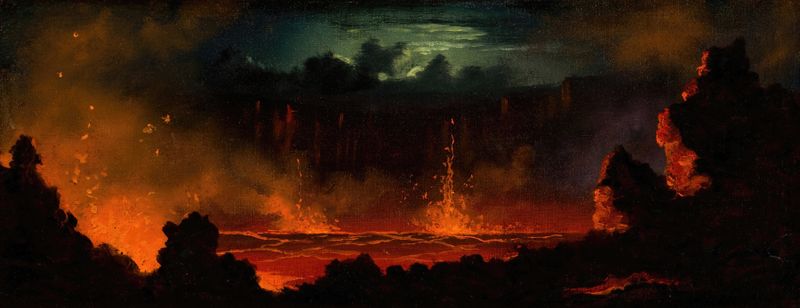
What if beauty was never meant to be finished? In Kilauea at Night, the fiery glow of molten lava dances against the darkness, suggesting a world caught in perpetual transformation. This radiant spectacle beckons us to wonder about the nature of creation and destruction, evoking both awe and reverence. To fully appreciate Tavernier's work, look closely at the vibrant orange and red hues that swirl and pulse on the canvas. Notice how they contrast sharply with the deep blues and blacks of the night sky, creating a palpable tension between the calm of the heavens and the tumult of the earth.
The eruption is portrayed with energy, as wisps of smoke curl upward, drawing your gaze to the luminous core of the volcano. Each brushstroke captures not just the lava’s glow, but also the very essence of movement, crafting a dynamic interplay between light and shadow. Beneath the surface, the painting reveals deeper meanings about the duality of nature. The explosion of color signifies not only destruction but also the birth of new land, echoing the cycle of life inherent in volcanic activity.
This juxtaposition speaks to human existence, suggesting that beauty often arises from chaos. The foreground, with its jagged rocks, stands as a reminder of the terrain’s violence, yet the light it casts hints at hope, illuminating the path to renewal. In 1887, while living in California, Tavernier painted Kilauea at Night, inspired by his travels to Hawaii. This period in his life was marked by exploration and a growing fascination with the natural world, a time when artists sought to capture the sublime forces of nature.
His work reflects broader artistic movements that celebrated the awe-inspiring power of the environment, placing him at the forefront of a transformative era in landscape painting.